Mike Bara just posted this mini-video [NOW REMOVED FOR VIOLATION OF YT GUIDELINES: i.e. BLATANTLY UNTRUE] of him walking through the Emergency Room at the Auburn Medical Center south of Seattle.
There are no lines of panicked patients, no dead bodies on gurneys. Bara concludes by saying "There is no COVID-19 epidemic whatsoever in Seattle."
The Seattle Times would disagree. Yesterday the paper published these maps of the trend:
Auburn and Seattle are both in King County, where 136 of the 2,077 confirmed cases have died. The trend histogram clearly shows exponential growth.
The Medical Center's web site makes it plain that visitor restrictions are in effect, and patients who believe they may have the symptoms of coronavirus infection are advised to call before coming to the facility. Visitors are being screened (surely Bara must have noticed this??), and those with symptoms are not being allowed to enter the premises.
I think Mike Bara is looking in the wrong place for victims.
I never said they were on the streets, did I?
Mike Bara's followers (see YouTube comments) clearly think he's proved that the entire COVID-19 scare is a hoax perpetrated by the New World Order to facilitate their global takeover. But there's a deeper level of paranoia even than that. Last week Kerry Cassidy tweeted TANKS SEEN IN DOWNTOWN L.A. She then showed a picture of tanks loaded on train cars.
Showing posts with label bara delusions. Show all posts
Sunday, March 29, 2020
Tuesday, February 25, 2020
Mike Bara and wormholes
Mike Bara, the world-famous theoretical physiscistphysicistnote 1, was given the second half of Coast to Coast AM last night. The peg was the 78th anniversary of the "Battle of Los Angeles"—an event that saw anti-aircraft crews peppering a weather balloon in the mistaken belief that it was part of a Japanese attack. Bara, naturally, preferred the version of the story that makes the balloon into an extraterrestrial flying machine piloted by LGM. You either believe that or you don't. I don't, personally.
That little fantasy wasn't nearly enough to fill the allocated two hours—even allowing for the torrent of commericals C2C is now allowing itself—so George Noory moved on. "Of all the things you've investigated," he said,"which one gets you the most excited?" I thought Bara would say "The Bermuda Triangle" in order to plug his most recent book (which has been hammered by Amazon reader reviews). But no, what gets Mike all fizzy today is wormholes. He said "I believe wormhole technology has been solved. It'll be announced later this year. We'll be able to travel faster than light to the stars!!!"
Well, y'know, there's no such thing as "wormhole technology" and never will be. It's not a technology and hardly even a science—more of a mathematical exhibit. Wormholes are a theoretical consequence of general relativity, invented (as a means of space travel) by Kip Thorne more as a way of teaching relativity than a speculation about what we humans might actually be up to in another 1,000 years. I like to think that Prof. Thorne rolls his eyes somewhat when he hears of half-educated nincompoops like Mike Bara misunderstanding his work.
Change at Châtelet
My question to wormhole-believers is this: Supposing you did find the entrance to a wormhole. How in hell would you know where in the universe it pops back up into reality? It might not be anywhere you're remotely interested in going. If you're lost in Paris, you can always study the map of the Métro and eventually get it. «Direction Porte de Clignancourt, six stops, change at Châtelet, direction Mairie des Lilas, four more stops.» But in a womhole-rich universe, there's no Métro map and no changing at Châtelet. You disappear and re-appear in some location over which you have no control. Is that really practical, do you think?
Another problem is that, unlike the Paris Métro (other than during industrial strikes, of course) there's no guarantee that a reverse hole exists to get you back home. Like the failed Mars One scheme of a few years ago, it's a one-way ticket if it's a ticket at all.
Oh God! It's just occurred to me that perhaps the reason Bara made this topic his front page headline last night was because that'll be the subject of his next book. God save us, and save the trees!!!
Update:
In the movie of "Contact" it's not made clear, but in fact Carl Sagan had the idea that a very advanced civilization might be able to artificially construct a two-way wormhole specifically for the purpose of superluminal travel between points A and Z. That's like closing the Paris Métro except Line 4, then closing all the intermediate stations so that the only possible journey is between Porte d'Orléans and Porte de Clignancourt. It's hard to imagine that being very popular.
If this is the sort of thing Mike Bara means when he referes to "Wormhole technology" he's dreaming. Well, we knew that, I guess.
==========================/ \======================
[1] Just kidding. "Former CAD-CAM technician" is the truth.
That little fantasy wasn't nearly enough to fill the allocated two hours—even allowing for the torrent of commericals C2C is now allowing itself—so George Noory moved on. "Of all the things you've investigated," he said,"which one gets you the most excited?" I thought Bara would say "The Bermuda Triangle" in order to plug his most recent book (which has been hammered by Amazon reader reviews). But no, what gets Mike all fizzy today is wormholes. He said "I believe wormhole technology has been solved. It'll be announced later this year. We'll be able to travel faster than light to the stars!!!"
Well, y'know, there's no such thing as "wormhole technology" and never will be. It's not a technology and hardly even a science—more of a mathematical exhibit. Wormholes are a theoretical consequence of general relativity, invented (as a means of space travel) by Kip Thorne more as a way of teaching relativity than a speculation about what we humans might actually be up to in another 1,000 years. I like to think that Prof. Thorne rolls his eyes somewhat when he hears of half-educated nincompoops like Mike Bara misunderstanding his work.
Change at Châtelet
My question to wormhole-believers is this: Supposing you did find the entrance to a wormhole. How in hell would you know where in the universe it pops back up into reality? It might not be anywhere you're remotely interested in going. If you're lost in Paris, you can always study the map of the Métro and eventually get it. «Direction Porte de Clignancourt, six stops, change at Châtelet, direction Mairie des Lilas, four more stops.» But in a womhole-rich universe, there's no Métro map and no changing at Châtelet. You disappear and re-appear in some location over which you have no control. Is that really practical, do you think?
Another problem is that, unlike the Paris Métro (other than during industrial strikes, of course) there's no guarantee that a reverse hole exists to get you back home. Like the failed Mars One scheme of a few years ago, it's a one-way ticket if it's a ticket at all.
Oh God! It's just occurred to me that perhaps the reason Bara made this topic his front page headline last night was because that'll be the subject of his next book. God save us, and save the trees!!!
Update:
In the movie of "Contact" it's not made clear, but in fact Carl Sagan had the idea that a very advanced civilization might be able to artificially construct a two-way wormhole specifically for the purpose of superluminal travel between points A and Z. That's like closing the Paris Métro except Line 4, then closing all the intermediate stations so that the only possible journey is between Porte d'Orléans and Porte de Clignancourt. It's hard to imagine that being very popular.
If this is the sort of thing Mike Bara means when he referes to "Wormhole technology" he's dreaming. Well, we knew that, I guess.
==========================/ \======================
[1] Just kidding. "Former CAD-CAM technician" is the truth.
Monday, July 8, 2019
Wrap-up of "Truth Behind the Moon Landing"
"Seeing how much time and effort was wasted to placate an idiot that is just too stupid to understand how telescopes and cameras work. This show is more or less just an indictment of the education system."That's one of the user reviews of Truth Behind the Moon Landing on IMDB, signed "codydwyer". There are some even less polite ones. In my humble opinion "codydwyer" is one smart man, and absolutely right. The series ended last night, with Mike Bara, Leland Melvin and Chad Jenkins all fist-bumping saying "Case closed. We went to the Moon". Earlier in S1E6 the three spent a ridiculous amount of time debating why the US flag appeared to flutter on the Moon (Mythbusters did a far better job of that and, indeed, of almost everything else this sorry excuse for a TV show touched). Chasing the theory that the film and TV record was all created in Hollywood, the trio interviewed Peter Hyams, Director/Writer of Capricorn One, and Doug Trumbull, legendary visual effcts designer for 2001: A Space Odyssey among other masterpieces. Trumbull politely said that No, Kubrick wasn't hired by NASA to create a total fake. Trumbull would know.
Throughout the series Mike Bara has been promoted as the Big Skeptic, pushing all the well-known fallacies such as that Apollo couldn't have survived the Van Allen radiation belts, that the Lunar Module couldn't have landed, bla-bla-bla. But we know this is all total pretense. Not only did Bara co-author a long two-part essay titled Who Mourns for Apollo?, he also wrote not one but two book chapters using that same title and vehemently affirming the reality of Apollo (Ancient Aliens on the Moon ch.6, and Ancient Aliens and JFK ch.8—the two texts are virtually identical).
Another IMDB reviewer wrote "Is Mike Bara really that stupid? Because if it's an act...he sucks at it."
I agree.
Thursday, May 30, 2019
Mike Bara tells us about another "Secret Space Program" that never happened
Mike Bara is just obsessed with the false idea that there's a secret US moonbase. He's totally wrong, as I pointed out in critiquing his books Hidden Agenda and Ancient Aliens and JFK. Just last month, I reviewed a long article by Clyde Lewis that repeated a couple of Bara's fantasies, namely:
Tell the truth
In last night's vlog, titled "Tell the Truth Wednesday", Bara mentioned both those fantasies all over again, and spent quite a long time talking about what he called another US secret space program. "It was totally secret," he stated. It was something "that nobody ever told you about." He even said "we were lied to back in the 60s".
OMG, a real secret??? What could this be??? Well, it turns out that he was talking about the USAF's dream project, the Manned Orbital Laboratory. Just like Project Horizon, the point to bear in mind about MOL is that it never flew. As for its secrecy, it might have been classified for a year or two but it became public knowledge in December 1963. It was cancelled in 1969.note 1
- Project Horizon may not have been cancelled but secretly built.
- Wikileaks posted a reference to a report that the USSR destroyed a secret US moonbase (but not the report itself, or even a link to it).
Tell the truth
In last night's vlog, titled "Tell the Truth Wednesday", Bara mentioned both those fantasies all over again, and spent quite a long time talking about what he called another US secret space program. "It was totally secret," he stated. It was something "that nobody ever told you about." He even said "we were lied to back in the 60s".
OMG, a real secret??? What could this be??? Well, it turns out that he was talking about the USAF's dream project, the Manned Orbital Laboratory. Just like Project Horizon, the point to bear in mind about MOL is that it never flew. As for its secrecy, it might have been classified for a year or two but it became public knowledge in December 1963. It was cancelled in 1969.note 1
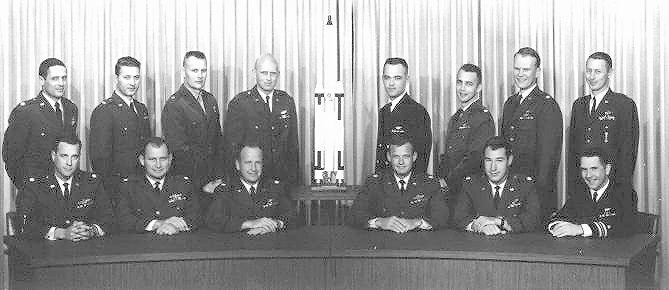
Bara got all excited about this image posing 14 of the 17 MOL astronauts. This, apparently, is what he meant when he said "we were lied to"—meaning, we weren't told about these astronauts. Well, we sure were when this picture was released, weren't we?
See that guy in naval uniform, bottom row extreme right? That's Dick Truly, who switched to NASA immediately MOL was cancelled and flew STS-2 and STS-8. He became the 8th NASA Administrator, in office 1989-1992.
Other Shuttle astronauts in that picture are Henry Hartsfield , Bob Overmyer, Gordon Fullerton, Bob Crippen, Don Peterson and Karol Bobko.
So if Mike Bara wants us to believe that MOL, like Horizon, may not have really been cancelled, he's going to have to explain how it could have continued when at least seven of its key crewmen had moved on to NASA.
Bait 'n' switch
Bara obviously thinks dark hints about seekrit space programs have consumer appeal, and perhaps he's right. But his problem is, he can't deliver what he promises his consumers. In 2016 he wrote Hidden Agenda: NASA and the Secret Space Program, but he was forced by lack of honest material to pad it out with Vimanas, The EM Drive (which not only has nothing to do with space but is also notably UN-secret), Explorer 1 (which he totally mis-reported for the third time), the early unmanned moonshots, and technology transfer from the Roswell "crash." When it comes to actual space programs, all he has in his black bag is these military dreams that were cancelled before ever coming to fruition. I hope his readers are suitably annoyed with him.
==================/ \========================
[1] Personally I doubt it would ever have worked as intended. The crew would have been launched in a modified Gemini, then had to float through a hole in the heat shield into the main space. A very dangerous design.
Thursday, November 29, 2018
Mike Bara tweaks the color of Mars
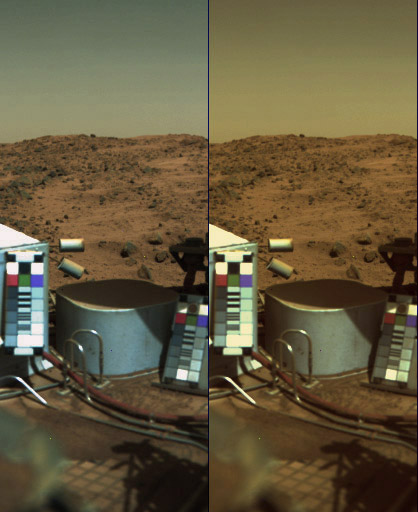
The question of the authentic color of the Martian sky raised its ugly head once more as soon as the first image from the InSight lander was available two days ago. I argued a bit with a blog commenter just yesterday on that very question. Adrian asserted that "They [nasa] actually for years used filters in order to create the illusion that on Mars everything looks a bit red/orange," and I denied it, citing the page made by space artist Don Davis on the question. Don makes the point that the color of a scene is highly dependent on the color of the light that is illuminating it. He shows this photo-pair from a Viking lander:
On the right is the best rendering of the scene actually on Mars. On the left is the scene as it would look if lit by a sunlit sky on Earth. Don is making the point that the sunlight on Mars is filtered by the rust-colored dust that's always in the atmosphere of Mars.
The accusation that NASA/JPL deliberately reddens Martian skies derives, I believe, from the very first image from Viking Lander 1 that included the sky. What that image did NOT include was the color reference chart, so the color graders at JPL had to guess. The first-released version had a creamy sky, as I recall. Later, when the color chart was included in some frames, they went back and regraded that first image, and issued a corrected version that was noticeably redder.
In his book "Postcards from Mars," Jim Bell explains all this, explains that the color of Martian skies varies according to how much dust is up there, and settles on "butterscotch" as the color of a "normal" Martian sky when just an average amount of dust is in the atmosphere.
See--NASA is lying!!!!
NASA haters love to show this image, from a press conference at JPL on 10 January 2004. That day, the brand new rover was Spirit, and a frame from Spirit's pancam (designed by Jim Bell, by the way) was back-projected behind the speaker panel.
The haters say this absolutely proves the point. But, you see, it doesn't. The fact that there are human faces in front of this frame makes any discussion of color balance on the original useless. The scene was lit by artificial light—most likely fluorescent, that casts a greenish spectrum on everything—and the whole composite picture was color-balanced to make the flesh tones look natural. Basically, this photo may be the only example of a red herring that is actually blue.
Now to the interesting part. Mike Bara, in his latest "Tell the Truth Wednesday" vlog, makes exactly the same mistake. He shows this version of the first frame from InSight:
Then he shows us this:
.....but once again, there is human flesh in the foreground, just as there was at the Spirit press conference. This cannot be the truest representation of the Martian sky, for that reason.
Forcing the whites
Bara went on to even more dishonesty and misunderstanding. He shows us this InSight frame, as an example of what he says is NASA flim-flammery.
Bara then gets out his favorite image editing software—Microsoft Office Paint, for Gods's sake—and proceeds to show us how he goes about "correcting" JPL's deceptions. He says that Instrument Deployment Arm, over on the right, should be white. The fact that it doesn't appear to be white is proof, to him, that this image is all wrong. So he uses the white balance feature of MS Paint to click on the arm and damn well force it to go white. Behold, the sky goes white too!!
Well, yes, of course it does. But it's this result that's deceptive, not the one Bara showed before he corrupted it with his little MS Paint click-me thingy. He simply doesn't understand the point that Don Davis explained so well—the subjective color of objects is highly influenced by the color of the light that is illuminating them.
It seems obvious to me that the objective of planetary color graders should be to show us, as close as possible, what the scene would look like if we were actually standing there looking at it. And that inevitably means taking into account the color of the ambient light. Mike Bara's white sky is just a ridiculous joke.
Quite apart from all this photographic logic, would somebody please tell me what possible motive NASA/JPL would have for pushing the Martian sky red-wards more than is justified?
Update 20 December: Chris Lawrence reports:
Bara returned to this topic in his "Tell the Truth Wednesday" vlog yesterday. At 15:50, after spending a few minutes calling NASA liars, he popped up an image of Mars. He says:
If you click "Fast Facts" on the Mars image you can see details about its construction. It's a colour-composite:
This image is a composite of separate exposures acquired by the WFC3/UVIS instrument. Several filters were used to sample various wavelengths. The color results from assigning different hues (colors) to each monochromatic (grayscale) image associated with an individual filter. In this case, the assigned colors are:
- Purple: F275W (275nm)
- Blue: F410M (410nm)
- Green: F502N (502nm)
- Red: F673N (673nm)
This page explains what you're seeing in these images. Mars' atmosphere does scatter blue light and this gives the blue limb in the composite. Stuart Robbins covered this exact topic in his Exposing Pseudo Astronomy Podcast #113 in June 2014.
Perhaps Bara can move his vlog to the weekend and rebrand it "Making Shit Up Saturday".
On the right is the best rendering of the scene actually on Mars. On the left is the scene as it would look if lit by a sunlit sky on Earth. Don is making the point that the sunlight on Mars is filtered by the rust-colored dust that's always in the atmosphere of Mars.
The accusation that NASA/JPL deliberately reddens Martian skies derives, I believe, from the very first image from Viking Lander 1 that included the sky. What that image did NOT include was the color reference chart, so the color graders at JPL had to guess. The first-released version had a creamy sky, as I recall. Later, when the color chart was included in some frames, they went back and regraded that first image, and issued a corrected version that was noticeably redder.
In his book "Postcards from Mars," Jim Bell explains all this, explains that the color of Martian skies varies according to how much dust is up there, and settles on "butterscotch" as the color of a "normal" Martian sky when just an average amount of dust is in the atmosphere.
See--NASA is lying!!!!
NASA haters love to show this image, from a press conference at JPL on 10 January 2004. That day, the brand new rover was Spirit, and a frame from Spirit's pancam (designed by Jim Bell, by the way) was back-projected behind the speaker panel.
The haters say this absolutely proves the point. But, you see, it doesn't. The fact that there are human faces in front of this frame makes any discussion of color balance on the original useless. The scene was lit by artificial light—most likely fluorescent, that casts a greenish spectrum on everything—and the whole composite picture was color-balanced to make the flesh tones look natural. Basically, this photo may be the only example of a red herring that is actually blue.
Now to the interesting part. Mike Bara, in his latest "Tell the Truth Wednesday" vlog, makes exactly the same mistake. He shows this version of the first frame from InSight:
Ta-DAAAAA!!!! SEE, NASA IS LYING!!!!!! BLUE SKY!!!!!!!!!!
.....but once again, there is human flesh in the foreground, just as there was at the Spirit press conference. This cannot be the truest representation of the Martian sky, for that reason.
Forcing the whites
Bara went on to even more dishonesty and misunderstanding. He shows us this InSight frame, as an example of what he says is NASA flim-flammery.
Bara then gets out his favorite image editing software—Microsoft Office Paint, for Gods's sake—and proceeds to show us how he goes about "correcting" JPL's deceptions. He says that Instrument Deployment Arm, over on the right, should be white. The fact that it doesn't appear to be white is proof, to him, that this image is all wrong. So he uses the white balance feature of MS Paint to click on the arm and damn well force it to go white. Behold, the sky goes white too!!
Well, yes, of course it does. But it's this result that's deceptive, not the one Bara showed before he corrupted it with his little MS Paint click-me thingy. He simply doesn't understand the point that Don Davis explained so well—the subjective color of objects is highly influenced by the color of the light that is illuminating them.
It seems obvious to me that the objective of planetary color graders should be to show us, as close as possible, what the scene would look like if we were actually standing there looking at it. And that inevitably means taking into account the color of the ambient light. Mike Bara's white sky is just a ridiculous joke.
Quite apart from all this photographic logic, would somebody please tell me what possible motive NASA/JPL would have for pushing the Martian sky red-wards more than is justified?
Update 20 December: Chris Lawrence reports:
Bara returned to this topic in his "Tell the Truth Wednesday" vlog yesterday. At 15:50, after spending a few minutes calling NASA liars, he popped up an image of Mars. He says:
15:50 "By the way this is the only Hubble image of Mars ever taken, and as you can see from the limb around the planet the sky quite clearly... this is the airglow limb... is blue and not red, in fact the red is grossly exagerrated in this image, and although Mars is kinda red it's not really really super red, so I think we can kinda pretty much settle on that."The image in question is this one taken by Hubble when Mars was near Opposition in May 2016. Far from being the only image ever taken it's one of many images of Mars taken by Hubble going back to 1991, a year after Hubble launched.
If you click "Fast Facts" on the Mars image you can see details about its construction. It's a colour-composite:
This image is a composite of separate exposures acquired by the WFC3/UVIS instrument. Several filters were used to sample various wavelengths. The color results from assigning different hues (colors) to each monochromatic (grayscale) image associated with an individual filter. In this case, the assigned colors are:
- Purple: F275W (275nm)
- Blue: F410M (410nm)
- Green: F502N (502nm)
- Red: F673N (673nm)
This page explains what you're seeing in these images. Mars' atmosphere does scatter blue light and this gives the blue limb in the composite. Stuart Robbins covered this exact topic in his Exposing Pseudo Astronomy Podcast #113 in June 2014.
Perhaps Bara can move his vlog to the weekend and rebrand it "Making Shit Up Saturday".
Friday, November 2, 2018
Yes, Mike Bara, you are crazy
At 45:40 in his latest vlog, Mike Bara says "People are going to say I'm crazy; go right ahead. Tell me I'm crazy."
YES BARA, YOU'RE CRAZY. You're also, in my opinion...
[x] Ignorant
[x] Insensitive
[x] Arrogant
[x] Lacking in human decency
[x] Unoriginal
The latest evidence of Bara's craziness, ignorance and insensitivity is the utterly nauseating theory that the crew of Space Shuttle Challenger all survived on 28 January 1986, but for unexplained reasons their survival was covered up and they now have new lives. Ugh. I'm not even going to re-post the pictures that are alleged to show them as they are today, this is such a trashy idea.
Bara bases this theory—not his own idea, by the waynote 1—on the fact that on CBS video a parachute was seen floating toward the ocean very soon after the spacecraft broke up.
He says he believes Challenger had an undeclared back-up escape system, and that the parachute was in fact carrying the entire crew cabin safely Earthwards.
Well, he was dead wrong about the cause of the Columbia diasaster, and he's dead wrong about this as well. Set aside, if you like, the ridiculous ideas that NASA would a) Not come clean about the crew escape systems that had been the subject of so much debate in the technical press, and b) Fail to report that the crew were alive. Set aside, if you like, the public funerals of the crew. The fact is, we know what that parachute was carrying and why, and it was definitely not the cabin.
Nose cap
The two solid rocket boosters (SRBs), designed for reuse and to prevent major damage after they have flamed out and separated, were equipped with a parachute system to slow the rate of descent. At an altitude of about 15,400 feet, a barometric pressure sensor fired three small thrusters that ejected the nose cap of the booster. The nose cap itself floated back to Earth on a small drogue parachute, and what was seen on the CBS video was the nose cap of the right-hand SRB.note 2
There's another technical consideration, too. It's unthinkable that something as massive as the fully-occupied Shuttle crew cabin could be controlled by a single small parachute. I doubt if anyone ever calculated the mass of that assembly, since it was never designed to be a separate object, but it must surely be many times the mass of the Apollo Command Module, which required three very large 'chutes to bring it home.note 3 Bara claims expertise in aeronautics and he should know these things.
These days Bara is describing himself as "a space expert." When I was active in the spaceflight specialist press, space experts actually knew their facts.
....and by the way, Mister Space Expert, the mission was not designated STS-25 as you said in your ridiculous vlog. It was STS-51-L.
Thanks again to Chris Lawrence for monitoring
=====================/ \===================
[1] This, dated July 2015, may be the original
[2] Text partly copied from UPI archives.
[3] There was redundancy. Apollo 15 splashed down successfully with one chute collapsed. Trivia: The third 'chute initially deployed correctly but its risers were damaged by the RCS surplus fuel dump.
YES BARA, YOU'RE CRAZY. You're also, in my opinion...
[x] Ignorant
[x] Insensitive
[x] Arrogant
[x] Lacking in human decency
[x] Unoriginal
The latest evidence of Bara's craziness, ignorance and insensitivity is the utterly nauseating theory that the crew of Space Shuttle Challenger all survived on 28 January 1986, but for unexplained reasons their survival was covered up and they now have new lives. Ugh. I'm not even going to re-post the pictures that are alleged to show them as they are today, this is such a trashy idea.
Bara bases this theory—not his own idea, by the waynote 1—on the fact that on CBS video a parachute was seen floating toward the ocean very soon after the spacecraft broke up.
He says he believes Challenger had an undeclared back-up escape system, and that the parachute was in fact carrying the entire crew cabin safely Earthwards.
Well, he was dead wrong about the cause of the Columbia diasaster, and he's dead wrong about this as well. Set aside, if you like, the ridiculous ideas that NASA would a) Not come clean about the crew escape systems that had been the subject of so much debate in the technical press, and b) Fail to report that the crew were alive. Set aside, if you like, the public funerals of the crew. The fact is, we know what that parachute was carrying and why, and it was definitely not the cabin.
Nose cap
The two solid rocket boosters (SRBs), designed for reuse and to prevent major damage after they have flamed out and separated, were equipped with a parachute system to slow the rate of descent. At an altitude of about 15,400 feet, a barometric pressure sensor fired three small thrusters that ejected the nose cap of the booster. The nose cap itself floated back to Earth on a small drogue parachute, and what was seen on the CBS video was the nose cap of the right-hand SRB.note 2
There's another technical consideration, too. It's unthinkable that something as massive as the fully-occupied Shuttle crew cabin could be controlled by a single small parachute. I doubt if anyone ever calculated the mass of that assembly, since it was never designed to be a separate object, but it must surely be many times the mass of the Apollo Command Module, which required three very large 'chutes to bring it home.note 3 Bara claims expertise in aeronautics and he should know these things.
These days Bara is describing himself as "a space expert." When I was active in the spaceflight specialist press, space experts actually knew their facts.
....and by the way, Mister Space Expert, the mission was not designated STS-25 as you said in your ridiculous vlog. It was STS-51-L.
Thanks again to Chris Lawrence for monitoring
=====================/ \===================
[1] This, dated July 2015, may be the original
[2] Text partly copied from UPI archives.
[3] There was redundancy. Apollo 15 splashed down successfully with one chute collapsed. Trivia: The third 'chute initially deployed correctly but its risers were damaged by the RCS surplus fuel dump.
Thursday, July 26, 2018
Mike Bara: Maximum hubris
This morning Mike Bara tweeted "Thanks for the confirmation of my work guys..." He was referring to the announcementnote 1, yesterday, that Italian scientists analyzing data collected by the MARSIS radar of the ESA's Mars Express have confirmed the existence of a substantial sub-surface lake below the Planum Australe region of Mars.
By "my work" he meant the so-called Mars Tidal Model, according to which the planet Mars was once tidally locked to a sister planet which then exploded, splattering one hemisphere of Mars with debris. This blog has critically reviewed the theory passim, noting that the hemisphere that is so obviously splattered is NOT the one that would have been pointing toward a hypothetical companion.
Not his work, not relevant anyway
Well, for one thing, the Tidal Model is not Bara's work. He's credited as second author but the work, such as it is, was accomplished by the primary author, Richard Hoagland. For a second thing, the announcement of liquid water 1.6 km underground near the south pole has no connection whatsoever to the tidal model.
This is far from the first time that Hoagland and/or Bara have blown their own false trumpets in reaction to astronomy news of the day. I think back to this claim from August 2008, and this one from October that year, in which Mike Bara stated that the hexagonal rings around the North pole of Saturn are "an inherent and specific prediction of the Hoagland\Torun Hyperdimensional physics model."note 2 In 2012 I coined the term Convenient Recall Adjustment Phenomenon (CRAP) for this kind of false recollection.
Bara was even given most of the first hour of Coast to Coast AM last night to comment on the Italian announcement (although, typically, he did not credit the authors.) He said "geometric structures" in the same region make him suspect that this area was once inhabited by a now-dead civilization, and perhaps the underground lake was a water source for them. George Noory invited him to extend his comments to Mars, and the Moon, more generally ("What's goeeeen on, Mike?") To my mind, conferring the status of "expert" on someone who is so totally wrong about the nature of the Moon is an admission of failure.
========================/ \========================
[1] Radar evidence of subglacial liquid water on Mars: Orosei et al, "Science" 25 July 2018
[2] This is what astronomers refer to as "bullshit." There is no documentary evidence that either Hoagland, Torun or Bara ever predicted the phenomenon.
By "my work" he meant the so-called Mars Tidal Model, according to which the planet Mars was once tidally locked to a sister planet which then exploded, splattering one hemisphere of Mars with debris. This blog has critically reviewed the theory passim, noting that the hemisphere that is so obviously splattered is NOT the one that would have been pointing toward a hypothetical companion.
Not his work, not relevant anyway
Well, for one thing, the Tidal Model is not Bara's work. He's credited as second author but the work, such as it is, was accomplished by the primary author, Richard Hoagland. For a second thing, the announcement of liquid water 1.6 km underground near the south pole has no connection whatsoever to the tidal model.
This is far from the first time that Hoagland and/or Bara have blown their own false trumpets in reaction to astronomy news of the day. I think back to this claim from August 2008, and this one from October that year, in which Mike Bara stated that the hexagonal rings around the North pole of Saturn are "an inherent and specific prediction of the Hoagland\Torun Hyperdimensional physics model."note 2 In 2012 I coined the term Convenient Recall Adjustment Phenomenon (CRAP) for this kind of false recollection.
Planum Australe: WHAT geometric structures?
Bara was even given most of the first hour of Coast to Coast AM last night to comment on the Italian announcement (although, typically, he did not credit the authors.) He said "geometric structures" in the same region make him suspect that this area was once inhabited by a now-dead civilization, and perhaps the underground lake was a water source for them. George Noory invited him to extend his comments to Mars, and the Moon, more generally ("What's goeeeen on, Mike?") To my mind, conferring the status of "expert" on someone who is so totally wrong about the nature of the Moon is an admission of failure.
========================/ \========================
[1] Radar evidence of subglacial liquid water on Mars: Orosei et al, "Science" 25 July 2018
[2] This is what astronomers refer to as "bullshit." There is no documentary evidence that either Hoagland, Torun or Bara ever predicted the phenomenon.
Tuesday, October 18, 2016
Point-by-point critique of Mike Bara's HIDDEN AGENDA
The full title of this book is Hidden Agenda: NASA and the Secret Space Program, and it's really awful. An embarrassment.
I think I can guess how this book came about. David Hatcher Childress called Mike Bara up back in March, saying "Well Mike, your last two books sold like shit, but if you want to have another go this year, I'll publish it." So Mike, having no special idea for a book, just looked through stuff he's written before, checked what the hot topics du jour were on ATS, and said "Sure, I'll cobble something together."
So here we have a real potboiler, and a slim one at that (192 pp., cf. 266 for last year's book.) As far as I know there's nothing original here at all--Bara merely plundered his own archives and those of other people (notably his former co-author Richard Hoagland.) It's what Chris Lawrence (a regular commenter here) calls "Ctrl-C/Ctrl-V scholarship."
David Childress, the publisher, has been marginally less stingy than usual on this one. He didn't pay the $750-odd it would have cost to make an index, but he stumped up for an 8-page color signature, and he presumably shelled out a bit for copy editing. I only counted five keyboard errors in the whole book, and we know Mike Bara averages way more than that. The chapter header on every page of chapter 7 is incorrect--oops. It's a dead giveaway that the book was composed on Microsoft Word™, whose section header controls are notoriously slippery.
So here goes with 14 specific points:
1. pp. 24-27. Vimanas. This meme is so well-known in woo-woo circles that it's the name of an arcade game released in 1991 ("Taking place in an unnamed solar system, a devastating war overtakes an inhabited alien planet.... bla bla bla".) It's an article of faith for UFO loonies to believe Vimanas were advanced flying machines developed in ancient India, but they are almost certainly mythological, designed to inspire awe but having no reality (why am I thinking of Deepak Chopra and yogic flying?) Almost half the text on these four pages is Ctrl-C/Ctrl-V from internet sources like wikipedia. No sign of anything that might be called a Secret Space Program (SSP) yet.
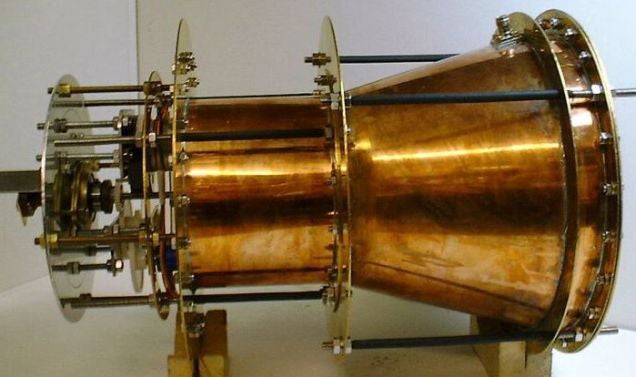
2. p.85. The EM Drive. In the intervening pages we've scampered through Roswell, the Nazi Bell and Majestic-12, plus other standard UFO topics. There's nothing specifically to criticize here-- Bara is simply treading well-worn paths, and there's still no SSP. Bara writes of the EM Drive that "the results were astounding" when tests were done at the Northwestern Polytechnic University in Xi'an, China. Very funny. These results have now been shown to be experimental error. As Stuart Robbins of Exposing Pseudoastronomy pointed out in July 2015, the largest measured thrust (in the micro-newton range) was from the control experiment. I blogged about this a year ago, and here's a sensible article about it. Here's another one.
Bara writes that superconduction could theoretically increase thrust by a factor of 1,000, but that has not been shown. Interest in the EM Drive has already tapered off, and I expect it to go to zero pretty soon. And by the way, since there's nothing secret about this device, I feel entitled to ask WTF it's doing in this book.
3. pp. 87-89 Explorer 1. These pages are Ctrl-C/Ctrl-V from Bara's own work, as he repeats his catastrophically faulty analysis of the orbit of America's first satellite. The planned orbit was 220 x 1000 miles, and the actual orbit was 225 x 1594 miles. A layman might say "That's a 60% higher orbit than expected," and that's just what Bara, a layman in this science, does say. He writes "I can't emphasize how impossible this is" (missing word there, I believe.) But it's not impossible if the calculation is done right. The 60% excess just applies to the apogee measured from the surface of the Earth. And that's not a very useful factor in assessing the energy in the orbit. That can only be done by comparing the planned vs. actual semi-major axis of the entire orbit. When done like that, with the diameter of the planet included, the answer is 4868 miles actual, 4571 planned; an excess of 6.5%. You only have to look at a diagram to see immediately that +60% is a major, major error.
This is what a 60% larger orbit would look like:
Three more points on this topic. a) Bara rejects all conventional explanations for the excess, insisting that it can only be an anti-gravity effect induced by the rotation of the rocket's upper stages. But Bara himself has the answer to this enigma without realizing it. He writes (p.93) that the reason the upper stages were rotated was "because it had a cluster assembly of solid rocket boosters which had a tendency to fire unevenly." Quite right--those little Baby Sergeant military rockets (15 in all) did indeed have unreliable thrust, and that's all the explanation you need for a 6.5% increase in energy.
b) What Bara fails to realize is that, by the time those solids fired, the stack was traveling horizontally, so anti-gravity effects would not be too much help.
c) Bara writes (p.88) "At the time, there were only three stations in the worldwide satellite tracking network." Not true. The Microlock network had five stations, and the Spheredrop network had five more. The stations were at Antigua, Earthquake Valley (near San Diego), Florida, Ibadan, Singapore, China Lake, Temple City, White Sands, Cedar Rapids and Huntsville.
4. pp.91-2 Luna, Pioneer, Ranger. On these pages Bara Ctrl-C's material from p.30 of his book Ancient Aliens on the Moon. He's fretting about the failure of early attempts to send spacecraft to the Moon. The Soviets went first with Luna 1, missing by 3,725 miles. Then came the DARPAnote 1 project Pioneer 4, missing by over 37,000 miles. NASA's Ranger 3 missed by 23,000 miles. Ranger 4 scored a hit but with dead systems. Bara ascribes all this failure to the fact that these spacecraft were either spin-stabilized or had spinning gyroscopes stabilizing them, and to his layman's mind spin induces surplus speed, accounting for the errors. But, as I wrote in September 2012, Luna 1's problem was an admitted mission management error, and in any case 3,725 miles is just 1.5% of the distance traveled. Pioneer 4 was never designed to impact the Moon-- it was a flyby, carrying a lunar radiation environment experiment. Rangers 3 & 5 suffered a whole series of booster malfunctions which were well understood before NASA launched Rangers 6 & 7 successfully.
What made me LOL was Bara writing (p.91) "Shooting the Moon ... should have been like shooting fish in a barrel. All you have to do is boost the probe into orbit, and then fire the thruster on a trajectory to the spot you know the Moon is going to be in two days." Those two sentences serve to emphasize what a total dilettante Bara is on this topic.
He writes that Wernher Von Braun "must have" figured out that rotation was the problem, and made allowances for it. Elsewhere he has written that Von Braun "sneaked" an additional term into the Tsiolkovsky rocket equation without anyone noticing. That got another LOL, or even a LMFAO. Now we're very close to half way through this book and still no sign of a SSP.
5. p.95 Well, lookee here--rumors of a SSP at last. Bara speculates that by the time NASA was created in 1958, the Russians had perfected anti-gravity technology for spaceflight. He thinks--without citing any evidence whatever--that Kennedy and Von Braun came to a crisis decision. "Rather than develop their own anti-gravity propulsion systems, the quicker solution is to simply go to the Moon, where they will likely find abandoned "Anunnaki" technology, and reverse engineer it." You gotta love that "simply" there, don'cha? So the Secret Space Program was just a layer of the very unsecret Project Apollo, according to Bara, and this is exactly what he said on Jimmy Church's Fade to Black podcast last June. The only part of the story we lack is EVIDENCE.
6. p.105. Bara writes here of Kennedy's May 1961 We Choose to Go to the Moon speech. He's confusing two different speeches here. May 1961 was the date of Kennedy's "I believe this nation should commit itself..." speech in Congress. "We Choose to Go to the Moon" was delivered at Rice University on 12 September 1962.
7. pp.110-115 Project Horizon. In my opinion, Project Horizon is a swing and a miss at a SSP. Yes, true, it was a US Army outpost on the Moon, proposed in 1959, to cost $7 billion and be home to 12 personnel by December 1966. Yes, it was canceled before any components were even built. But secret? For how long? The illustrations in Bara's own book make it obvious that before it was half built every amateur astronomer on Earth would be saying "Er...excuse me.. what's THAT THING?"
Bara writes (p.115) "I see no reason why these plans couldn't have been carried out behind the scenes, in parallel with the public NASA space program." You couldn't, eh Mike? How about the 61 Saturn I and 88 Saturn II launches it would have taken to get the job done? Think they could have been secret too? Don't those rocket thingies make a lot of... you know, NOISE?
8. pp. 115-126 Apollo 12. Now, 60% into the book, we're getting to the nitty gritty at last. Mike Bara alleges that whereas Apollo 11 was purely ceremonial, Apollo 12 was the start of the real seekrit effort to go get the Anunnaki technology. He's about 25% right. Apollo 11 was largely ceremonial, and Apollo 12 had as part of its mission the retrieval of technology. But the technology was ours to begin with--part of the soft-lander Surveyor 3 which had successfully touched down in Oceanus Procellarum in April 1967. Mike Bara offers us not even the ghost of a piece of evidence that alien technology was collected or even contemplated. Instead he gives us a cock-and-bull story. According to him, the accidental misuse of the color TV camera, shutting it down for the whole of both EVAs, was not an accident but deliberately contrived to avoid showing us plain evidence of alien ruins on the horizon. Well, this is really ridiculous. Quite apart from the hundreds of high-quality 70mm stills that the Apollo 12 astronauts shot, we have the following pseudo-evidence from Bara's former co-author Richard Hoagland. In promoting the book they wrote together, Dark Mission, Hoagland created a web page with some come-ons he thought would make punters buy the book. Among them was this picture, which he said showed Alan Bean deploying the ALSEP experiments on Apollo 12 with a backdrop of... you guessed it, alien ruins!!
Actually of course, those splotches in the sky (which also appear in the astronaut's shadow) are the result of Hoagland's photoshopping efforts with the brightness and curves controls. For comparison, here's an unmanipulated version of that image.
So here we have, on the one hand, Mike Bara telling us that Al Bean was so determined that we should not see what he was seeing that he deliberately ruined a vital piece of equipment, and on the other hand, Richard Hoagland (and Bara must have known about this too) showing us that Al Bean's fellow astronaut, Pete Conrad, was not at all shy about showing us the alien ruins. Both these propositions cannot be true, can they? Actually, neither of them is true. Apollo 12 was a supremely successful lunar mission that brought back only what it said it did, and there are no alien ruins at that site or anywhere else on the Moon.
9. p.117. Crystal towers? Bara here writeth: "I believe the Moon, especially the front side, is mostly covered by towering crystalline, glass-like structures which acted as a makeshift meteor shield for the various alien basses [sic, one of the five keyboard errors] operating on the surface below." By way of illustration, he adds an image, and here it is:
Know the only problem with that image? It's upside down. The original is a Lunar Reconnaissance Orbiter oblique shot showing landslides down the rim of Marius crater, in Oceanus Procellarum. Take a look.
This can only be deliberate deception, and as a reader of what's listed as a non-fiction book I don't take kindly to it. David Hatcher Childress, please take note. And by the way, if that's what Mike Bara really thinks the front side of the Moon is like he can't have spent much time studying the thousands of images we now have at a resolution of 0.8 metres/pixel. This error is truly awful.
10. p.123 The "secret radio channel." Bara writes that the Apollo astronauts, while on the Moon, had the ability to talk privately to Mission Control. He writes "One way is to use the bio-medical telemetry feed, which had duplex capability and could be used for private voice communication." Totally untrue. There never was any secret channel. The more mundane truth is that they could arrange to talk to the flight surgeon and/or their families without those conversations being released to the media. But they were conducted over the exact same S-Band link as all the other chit-chat. Mike Bara told the same story on Ancient Aliens S11E11, Space Station Moon. It's just wrong.
11. p.145 Technology transfer. Bara writes that fiber optics, lasers, integrated circuits and transistors were all technologies captured from the Roswell aliens. He believes this because he Ctrl-C/Ctrl-V'd it from Philip Corso's book The Day After Roswell. He writes that these technologies were "far beyond the industrial capacity of the United States at that time." Of those technologies, only the transistor saw any kind of breakthrough development in the second half of the 1940s, and that was undoubtedly due to William Shockley's patient work rather than any alien secrets. Fiber optics was not far beyond anyone in 1947--the technology was known but not mature. It took the idea of doping with titanium to make optical fibers really useful, and that didn't happen until 1970.
12. Chapter 7, pp.145-160. The header of this chapter is "The Whistleblowers," and as I started it, I was getting ready to roll my eyes at Ken Johnston's outrageous claims about NASA tampering with original negative film. In fact, Bara's heros are even worse. They include Bob Dean, who claims that certain of our celebrities are genetically modified Anunnakis. They include--incredibly--Bob Lazar, whose story is so utterly ridiculous that even the wackiest of the ATS crowd won't swallow it. Bara believes (p.155) that there are gigantic secret orbiting space platforms staffed by military officers. His evidence is from Youtube.
13. Chapter 8, pp.161-177. Just when I thought this insanity could get no worse, Bara came at me with an entire chapter on Project Serpo. Serpo was the mother of all space hoaxes, dreamed up by an author as publicity for his new book. It's so excruciating that I can't bear to write it up--readers are directed to the Rational Wikipedia article.
14. p.174 John Glenn. In this blog, February 2012, I had a good laugh at Richard Hoagland for totally misunderstanding John Glenn's guest appearance on the TV comedy show "Frasier" (March 2001.) On the show, Glenn agreed to go along with a joke which had him sitting down in a radio studio and blurting out a spoof confession about seeing aliens in space. The producers provided a laugh track just in case anybody thought Glenn's "confession" was real. Here's the sequence, see for yourselves, folks. Well, guess what? Here in this book Mike Bara totally falls for it, missing the joke. What's worse, he has the goddam nerve to call John Glenn a liar for having denied that same story in public. I nearly shredded this book in disgust. David Hatcher Childress, please take another note: Readers do not take kindly to whipper-snappers like University dropout Mike Bara insulting our foremost national hero. Decorated combat pilot, first American in orbit, oldest man to fly in space (STS-95), Senator for Ohio 1974-1999, Chair of the Senate Committee for Governmental Affairs 1987-1995, candidate for US Vice president 1976. On behalf of Senator Glenn, FUCK YOU, MIKE BARA.
========================/\========================
[1] Bara wrote DARPA (Defense Advanced Research Projects Agency.) Actually Pioneers 3 & 4 were joint projects of the Army Ballistic Missile Agency (Von Braun's outfit at the Redstone Arsenal, later MSFC) and JPL under the direction of NASA. It's noteworthy that these space probes were launched by Juno II, a rocket stack virtually identical to the one that launched Explorer 1. Although not a perfect performer, Juno II had 4 successes out of 10 launches.
I think I can guess how this book came about. David Hatcher Childress called Mike Bara up back in March, saying "Well Mike, your last two books sold like shit, but if you want to have another go this year, I'll publish it." So Mike, having no special idea for a book, just looked through stuff he's written before, checked what the hot topics du jour were on ATS, and said "Sure, I'll cobble something together."
So here we have a real potboiler, and a slim one at that (192 pp., cf. 266 for last year's book.) As far as I know there's nothing original here at all--Bara merely plundered his own archives and those of other people (notably his former co-author Richard Hoagland.) It's what Chris Lawrence (a regular commenter here) calls "Ctrl-C/Ctrl-V scholarship."
David Childress, the publisher, has been marginally less stingy than usual on this one. He didn't pay the $750-odd it would have cost to make an index, but he stumped up for an 8-page color signature, and he presumably shelled out a bit for copy editing. I only counted five keyboard errors in the whole book, and we know Mike Bara averages way more than that. The chapter header on every page of chapter 7 is incorrect--oops. It's a dead giveaway that the book was composed on Microsoft Word™, whose section header controls are notoriously slippery.
So here goes with 14 specific points:
1. pp. 24-27. Vimanas. This meme is so well-known in woo-woo circles that it's the name of an arcade game released in 1991 ("Taking place in an unnamed solar system, a devastating war overtakes an inhabited alien planet.... bla bla bla".) It's an article of faith for UFO loonies to believe Vimanas were advanced flying machines developed in ancient India, but they are almost certainly mythological, designed to inspire awe but having no reality (why am I thinking of Deepak Chopra and yogic flying?) Almost half the text on these four pages is Ctrl-C/Ctrl-V from internet sources like wikipedia. No sign of anything that might be called a Secret Space Program (SSP) yet.
2. p.85. The EM Drive. In the intervening pages we've scampered through Roswell, the Nazi Bell and Majestic-12, plus other standard UFO topics. There's nothing specifically to criticize here-- Bara is simply treading well-worn paths, and there's still no SSP. Bara writes of the EM Drive that "the results were astounding" when tests were done at the Northwestern Polytechnic University in Xi'an, China. Very funny. These results have now been shown to be experimental error. As Stuart Robbins of Exposing Pseudoastronomy pointed out in July 2015, the largest measured thrust (in the micro-newton range) was from the control experiment. I blogged about this a year ago, and here's a sensible article about it. Here's another one.
Bara writes that superconduction could theoretically increase thrust by a factor of 1,000, but that has not been shown. Interest in the EM Drive has already tapered off, and I expect it to go to zero pretty soon. And by the way, since there's nothing secret about this device, I feel entitled to ask WTF it's doing in this book.
3. pp. 87-89 Explorer 1. These pages are Ctrl-C/Ctrl-V from Bara's own work, as he repeats his catastrophically faulty analysis of the orbit of America's first satellite. The planned orbit was 220 x 1000 miles, and the actual orbit was 225 x 1594 miles. A layman might say "That's a 60% higher orbit than expected," and that's just what Bara, a layman in this science, does say. He writes "I can't emphasize how impossible this is" (missing word there, I believe.) But it's not impossible if the calculation is done right. The 60% excess just applies to the apogee measured from the surface of the Earth. And that's not a very useful factor in assessing the energy in the orbit. That can only be done by comparing the planned vs. actual semi-major axis of the entire orbit. When done like that, with the diameter of the planet included, the answer is 4868 miles actual, 4571 planned; an excess of 6.5%. You only have to look at a diagram to see immediately that +60% is a major, major error.
credit: Enterprise mission
This is what a 60% larger orbit would look like:
Three more points on this topic. a) Bara rejects all conventional explanations for the excess, insisting that it can only be an anti-gravity effect induced by the rotation of the rocket's upper stages. But Bara himself has the answer to this enigma without realizing it. He writes (p.93) that the reason the upper stages were rotated was "because it had a cluster assembly of solid rocket boosters which had a tendency to fire unevenly." Quite right--those little Baby Sergeant military rockets (15 in all) did indeed have unreliable thrust, and that's all the explanation you need for a 6.5% increase in energy.
b) What Bara fails to realize is that, by the time those solids fired, the stack was traveling horizontally, so anti-gravity effects would not be too much help.
c) Bara writes (p.88) "At the time, there were only three stations in the worldwide satellite tracking network." Not true. The Microlock network had five stations, and the Spheredrop network had five more. The stations were at Antigua, Earthquake Valley (near San Diego), Florida, Ibadan, Singapore, China Lake, Temple City, White Sands, Cedar Rapids and Huntsville.
4. pp.91-2 Luna, Pioneer, Ranger. On these pages Bara Ctrl-C's material from p.30 of his book Ancient Aliens on the Moon. He's fretting about the failure of early attempts to send spacecraft to the Moon. The Soviets went first with Luna 1, missing by 3,725 miles. Then came the DARPAnote 1 project Pioneer 4, missing by over 37,000 miles. NASA's Ranger 3 missed by 23,000 miles. Ranger 4 scored a hit but with dead systems. Bara ascribes all this failure to the fact that these spacecraft were either spin-stabilized or had spinning gyroscopes stabilizing them, and to his layman's mind spin induces surplus speed, accounting for the errors. But, as I wrote in September 2012, Luna 1's problem was an admitted mission management error, and in any case 3,725 miles is just 1.5% of the distance traveled. Pioneer 4 was never designed to impact the Moon-- it was a flyby, carrying a lunar radiation environment experiment. Rangers 3 & 5 suffered a whole series of booster malfunctions which were well understood before NASA launched Rangers 6 & 7 successfully.
What made me LOL was Bara writing (p.91) "Shooting the Moon ... should have been like shooting fish in a barrel. All you have to do is boost the probe into orbit, and then fire the thruster on a trajectory to the spot you know the Moon is going to be in two days." Those two sentences serve to emphasize what a total dilettante Bara is on this topic.
He writes that Wernher Von Braun "must have" figured out that rotation was the problem, and made allowances for it. Elsewhere he has written that Von Braun "sneaked" an additional term into the Tsiolkovsky rocket equation without anyone noticing. That got another LOL, or even a LMFAO. Now we're very close to half way through this book and still no sign of a SSP.
5. p.95 Well, lookee here--rumors of a SSP at last. Bara speculates that by the time NASA was created in 1958, the Russians had perfected anti-gravity technology for spaceflight. He thinks--without citing any evidence whatever--that Kennedy and Von Braun came to a crisis decision. "Rather than develop their own anti-gravity propulsion systems, the quicker solution is to simply go to the Moon, where they will likely find abandoned "Anunnaki" technology, and reverse engineer it." You gotta love that "simply" there, don'cha? So the Secret Space Program was just a layer of the very unsecret Project Apollo, according to Bara, and this is exactly what he said on Jimmy Church's Fade to Black podcast last June. The only part of the story we lack is EVIDENCE.
6. p.105. Bara writes here of Kennedy's May 1961 We Choose to Go to the Moon speech. He's confusing two different speeches here. May 1961 was the date of Kennedy's "I believe this nation should commit itself..." speech in Congress. "We Choose to Go to the Moon" was delivered at Rice University on 12 September 1962.
7. pp.110-115 Project Horizon. In my opinion, Project Horizon is a swing and a miss at a SSP. Yes, true, it was a US Army outpost on the Moon, proposed in 1959, to cost $7 billion and be home to 12 personnel by December 1966. Yes, it was canceled before any components were even built. But secret? For how long? The illustrations in Bara's own book make it obvious that before it was half built every amateur astronomer on Earth would be saying "Er...excuse me.. what's THAT THING?"
Bara writes (p.115) "I see no reason why these plans couldn't have been carried out behind the scenes, in parallel with the public NASA space program." You couldn't, eh Mike? How about the 61 Saturn I and 88 Saturn II launches it would have taken to get the job done? Think they could have been secret too? Don't those rocket thingies make a lot of... you know, NOISE?
8. pp. 115-126 Apollo 12. Now, 60% into the book, we're getting to the nitty gritty at last. Mike Bara alleges that whereas Apollo 11 was purely ceremonial, Apollo 12 was the start of the real seekrit effort to go get the Anunnaki technology. He's about 25% right. Apollo 11 was largely ceremonial, and Apollo 12 had as part of its mission the retrieval of technology. But the technology was ours to begin with--part of the soft-lander Surveyor 3 which had successfully touched down in Oceanus Procellarum in April 1967. Mike Bara offers us not even the ghost of a piece of evidence that alien technology was collected or even contemplated. Instead he gives us a cock-and-bull story. According to him, the accidental misuse of the color TV camera, shutting it down for the whole of both EVAs, was not an accident but deliberately contrived to avoid showing us plain evidence of alien ruins on the horizon. Well, this is really ridiculous. Quite apart from the hundreds of high-quality 70mm stills that the Apollo 12 astronauts shot, we have the following pseudo-evidence from Bara's former co-author Richard Hoagland. In promoting the book they wrote together, Dark Mission, Hoagland created a web page with some come-ons he thought would make punters buy the book. Among them was this picture, which he said showed Alan Bean deploying the ALSEP experiments on Apollo 12 with a backdrop of... you guessed it, alien ruins!!
Actually of course, those splotches in the sky (which also appear in the astronaut's shadow) are the result of Hoagland's photoshopping efforts with the brightness and curves controls. For comparison, here's an unmanipulated version of that image.
So here we have, on the one hand, Mike Bara telling us that Al Bean was so determined that we should not see what he was seeing that he deliberately ruined a vital piece of equipment, and on the other hand, Richard Hoagland (and Bara must have known about this too) showing us that Al Bean's fellow astronaut, Pete Conrad, was not at all shy about showing us the alien ruins. Both these propositions cannot be true, can they? Actually, neither of them is true. Apollo 12 was a supremely successful lunar mission that brought back only what it said it did, and there are no alien ruins at that site or anywhere else on the Moon.
9. p.117. Crystal towers? Bara here writeth: "I believe the Moon, especially the front side, is mostly covered by towering crystalline, glass-like structures which acted as a makeshift meteor shield for the various alien basses [sic, one of the five keyboard errors] operating on the surface below." By way of illustration, he adds an image, and here it is:
Know the only problem with that image? It's upside down. The original is a Lunar Reconnaissance Orbiter oblique shot showing landslides down the rim of Marius crater, in Oceanus Procellarum. Take a look.
This can only be deliberate deception, and as a reader of what's listed as a non-fiction book I don't take kindly to it. David Hatcher Childress, please take note. And by the way, if that's what Mike Bara really thinks the front side of the Moon is like he can't have spent much time studying the thousands of images we now have at a resolution of 0.8 metres/pixel. This error is truly awful.
10. p.123 The "secret radio channel." Bara writes that the Apollo astronauts, while on the Moon, had the ability to talk privately to Mission Control. He writes "One way is to use the bio-medical telemetry feed, which had duplex capability and could be used for private voice communication." Totally untrue. There never was any secret channel. The more mundane truth is that they could arrange to talk to the flight surgeon and/or their families without those conversations being released to the media. But they were conducted over the exact same S-Band link as all the other chit-chat. Mike Bara told the same story on Ancient Aliens S11E11, Space Station Moon. It's just wrong.
11. p.145 Technology transfer. Bara writes that fiber optics, lasers, integrated circuits and transistors were all technologies captured from the Roswell aliens. He believes this because he Ctrl-C/Ctrl-V'd it from Philip Corso's book The Day After Roswell. He writes that these technologies were "far beyond the industrial capacity of the United States at that time." Of those technologies, only the transistor saw any kind of breakthrough development in the second half of the 1940s, and that was undoubtedly due to William Shockley's patient work rather than any alien secrets. Fiber optics was not far beyond anyone in 1947--the technology was known but not mature. It took the idea of doping with titanium to make optical fibers really useful, and that didn't happen until 1970.
12. Chapter 7, pp.145-160. The header of this chapter is "The Whistleblowers," and as I started it, I was getting ready to roll my eyes at Ken Johnston's outrageous claims about NASA tampering with original negative film. In fact, Bara's heros are even worse. They include Bob Dean, who claims that certain of our celebrities are genetically modified Anunnakis. They include--incredibly--Bob Lazar, whose story is so utterly ridiculous that even the wackiest of the ATS crowd won't swallow it. Bara believes (p.155) that there are gigantic secret orbiting space platforms staffed by military officers. His evidence is from Youtube.
13. Chapter 8, pp.161-177. Just when I thought this insanity could get no worse, Bara came at me with an entire chapter on Project Serpo. Serpo was the mother of all space hoaxes, dreamed up by an author as publicity for his new book. It's so excruciating that I can't bear to write it up--readers are directed to the Rational Wikipedia article.
14. p.174 John Glenn. In this blog, February 2012, I had a good laugh at Richard Hoagland for totally misunderstanding John Glenn's guest appearance on the TV comedy show "Frasier" (March 2001.) On the show, Glenn agreed to go along with a joke which had him sitting down in a radio studio and blurting out a spoof confession about seeing aliens in space. The producers provided a laugh track just in case anybody thought Glenn's "confession" was real. Here's the sequence, see for yourselves, folks. Well, guess what? Here in this book Mike Bara totally falls for it, missing the joke. What's worse, he has the goddam nerve to call John Glenn a liar for having denied that same story in public. I nearly shredded this book in disgust. David Hatcher Childress, please take another note: Readers do not take kindly to whipper-snappers like University dropout Mike Bara insulting our foremost national hero. Decorated combat pilot, first American in orbit, oldest man to fly in space (STS-95), Senator for Ohio 1974-1999, Chair of the Senate Committee for Governmental Affairs 1987-1995, candidate for US Vice president 1976. On behalf of Senator Glenn, FUCK YOU, MIKE BARA.
========================/\========================
[1] Bara wrote DARPA (Defense Advanced Research Projects Agency.) Actually Pioneers 3 & 4 were joint projects of the Army Ballistic Missile Agency (Von Braun's outfit at the Redstone Arsenal, later MSFC) and JPL under the direction of NASA. It's noteworthy that these space probes were launched by Juno II, a rocket stack virtually identical to the one that launched Explorer 1. Although not a perfect performer, Juno II had 4 successes out of 10 launches.
Tuesday, September 29, 2015
Mike Bara, utterly delusional on Mars water
As every reader of this outpost of the blogosphere surely knows, NASA staged a major announcement yesterday confirming that recurring slope lineae (RSLs) on the walls of Martian craters, and the slopes of some Martian mountains, are indeed caused by recent flows of brine, as has long been thought. The visual evidence has been apparent at least since 1999. The difference now is that the CRISM spectrometer on Mars Reconnaissance Orbiter has added solid chemistry to dynamic seasonal morphology. Craters where RSLs were studied included Gari, Horowitz and Newton.
A couple of days before the formal announcement, when inspection of the list of speakers was an obvious spoiler, Mike Bara was already screaming on Twitter: "NASA is trying to steal my work ... from 15 years ago!"
Last night, on Jimmy Church's internet radio show Fade to Black, Bara went into full delusional hypermind. Church asked him "how did you feel about the way that it was presented?"
He didn't exactly specify when and in what medium he made this historic announcement, but since he named the date as 2001, and since he also mentioned Effrain Palermo as a co-worker, it's a safe bet that he was referring to the long web page authored by Richard Hoagland and himself, A New Model of Mars as a Captured Satellite -- often referred to as "The Mars Tidal Model" and reviewed by this blog passim.
The real history
Well, let's see. The dark streaking on Martian slopes shown by the camera of Mars Global Surveyor was noticed by authors Lori K. Fenton et al. in September 1998, just short of a year after MGS arrived at Mars. They published in Bulletin of the American Astronomical Society, Vol. 30, p.1054 a paper beginning:
On 19 July 2000, a month after the NASA announcement, Richard Hoagland issued a press release on slope streaks he had observed in Frame SP2-33806 from MGS. The location was the Eastern edge of Terra Arabia. Hoagland also claimed prior work in social media yesterday, proclaiming "I saw it first!" on the basis of this web page, although the fact that, in the press release, he specifically refers to the previous month's announcement by NASA makes him into a liar out of his own keyboard.note 2
The Mars Tidal Model essay is not precisely dated but it seems to be from almost a year later. It does include images of slope streaks (not at all the same thing as RSLs, as Stuart Robbins has pointed out on his blog), but it does not describe the formation of brine and does not, of course, include the chemical data from CRISM which has only very recently become available.
I don't mean to imply that Bara & Hoagland should be somehow prevented from telling these horrible self-serving lies. I believe in freedom of speech. I just think they deserve to be mocked for it. As long and as hard as possible.
==============================
[1] Although actually the authors of record were Michael Malin and Kenneth Edgett of Malin Space Science Systems. The paper was "Evidence for Recent Groundwater Seepage and Surface Runoff on Mars" Science 288 (5475): 2330–2335.
[2] I'm told he also stated on his own digital radio show last night "There are no craters on Mars."
Time-lapse animated gif of RSLs in crater Newton (released Aug.2011)
A couple of days before the formal announcement, when inspection of the list of speakers was an obvious spoiler, Mike Bara was already screaming on Twitter: "NASA is trying to steal my work ... from 15 years ago!"
Last night, on Jimmy Church's internet radio show Fade to Black, Bara went into full delusional hypermind. Church asked him "how did you feel about the way that it was presented?"
127:45 Bara: "They're telling us now what people like me, and people that listen to shows like this, knew 15 years ago. Which is that that there's water on Mars -- these dark slope streaks that you see coming down the insides of craters, and off mountain tops and stuff, are liquid water. Quite honestly, I was I think the first person in the world that said that's what it was, and this is the reasons why, and basically it was really gratifying on the one hand to read these articles on space.com and stuff basically confirming everything that I published along with my co-workers.. you know, 15 years ago. There's a certain gratification in being confirmed like that but... on the other hand it's really aggravating. Because, you realize that you're going to be swept aside or swept under the rug with "NASA now says this is true so now you can believe it" It's really kind of annoying. I'm trying not to let my ego get the better of me here, but it's really annoying sometimes to read my Facebook, and all thse people "Ooohhh, there's water on Mars!" They're my FB friends and I'm like "Do you folks not read my books? Why are we FB friends if you don't know what I do and why do we constantly have to fight? Why do we have to fight for the spotlight when we were first?"Yes, folks, you read that right.
131:28 Bara: "..the alternative researchers, the people on the outside, have been right all along. Tonight we should stick a feather in our cap and say "We won this one. Because we've turned out to be right and all of the NASA supporters really have turned out to be wrong." Because NASA's finally come around to the truth doesn't mean they were ever right about this -- they've been wrong all along.
He didn't exactly specify when and in what medium he made this historic announcement, but since he named the date as 2001, and since he also mentioned Effrain Palermo as a co-worker, it's a safe bet that he was referring to the long web page authored by Richard Hoagland and himself, A New Model of Mars as a Captured Satellite -- often referred to as "The Mars Tidal Model" and reviewed by this blog passim.
The real history
Well, let's see. The dark streaking on Martian slopes shown by the camera of Mars Global Surveyor was noticed by authors Lori K. Fenton et al. in September 1998, just short of a year after MGS arrived at Mars. They published in Bulletin of the American Astronomical Society, Vol. 30, p.1054 a paper beginning:
"The narrow angle MOC images from MGS show dozens of examples of dark streaks on Martian hillsides that may be indicative of fluid flow."Fenton et al. allowed that water was not the only possible explanation for what they observed. The most formal proposal that slope streaks were likely to be caused by recent running water was announced on 22 June 2000, and published in the 30 June issue of Science. The features of interest in that study were at Terra Sirenum and Centauri Montes — and the authors had waited a whole Martian year before making the announcement, so they could compare the terrain through the seasonal cycle and establish that the appearance of streaks coincided with warm weather. In other words, they had been tracking this phenomenon since March 1999. This was NASA,note 1 and the data was from Mars Global Surveyor.
On 19 July 2000, a month after the NASA announcement, Richard Hoagland issued a press release on slope streaks he had observed in Frame SP2-33806 from MGS. The location was the Eastern edge of Terra Arabia. Hoagland also claimed prior work in social media yesterday, proclaiming "I saw it first!" on the basis of this web page, although the fact that, in the press release, he specifically refers to the previous month's announcement by NASA makes him into a liar out of his own keyboard.note 2
The Mars Tidal Model essay is not precisely dated but it seems to be from almost a year later. It does include images of slope streaks (not at all the same thing as RSLs, as Stuart Robbins has pointed out on his blog), but it does not describe the formation of brine and does not, of course, include the chemical data from CRISM which has only very recently become available.
I don't mean to imply that Bara & Hoagland should be somehow prevented from telling these horrible self-serving lies. I believe in freedom of speech. I just think they deserve to be mocked for it. As long and as hard as possible.
==============================
[1] Although actually the authors of record were Michael Malin and Kenneth Edgett of Malin Space Science Systems. The paper was "Evidence for Recent Groundwater Seepage and Surface Runoff on Mars" Science 288 (5475): 2330–2335.
[2] I'm told he also stated on his own digital radio show last night "There are no craters on Mars."
Wednesday, July 29, 2015
Aaaaannnddd just like that, Mike Bara's daft ideas go out the window
"I’m completely confident that I can prove there’s no such thing as the laws of physics."Thus Mike Bara in September 2010, in a promo interview for his appalling book The Choice. Mike never got around to proving that or anything like it. Instead, he reminded us all about such frippery as Kirlian photography, Plant emotions, and the Princeton EGGs, as though they were brand new challenges to mainstream physics. Which they ARE NOT. Neither brand new nor challenges, other than as a sort of parlor game "Spot the logical flaw."
Ever since, Mike has apparently been on the lookout for fresh challenges to physics—without, of course, having the slightest understanding of the subject. Today he latches on to the EM Drive, the "miracle" rocket propulsion system that the Daily Telegraph assures usnote 1 could get to the Moon in four hours.
Unfortunately, The Daily Torygraph is not only counting chicks before they hatch but before the eggs have been laid, and possibly before the mother hen herself has cracked out. If this works, then pretty soon sitting in your car and pushing on the dashboard will work, too. As Bob Zimmerman correctly pointed out last night on Coast to Coast AM, the Abstract of the new paper by Tajmar & Fiedler (AIAA/SAE/ASEE Joint Propulsion Conference)note 2 includes these golden words:
"Our test campaign can not confirm or refute the claims of the EMDrive but intends to independently assess possible side-effects in the measurement methods used so far."The EM Drive "works" by bouncing microwaves around inside a closed chamber. A thrust of around 20 micro-newtons has been observed.note 3 Your computer mouse probably exerts a thrust of around 1 Newton on the desk—it sure ain't going to take you to the Moon any time soon.
Mike Bara's tweetery on the subject was "Aaaaannnddd just like that the "laws" of physics go out the window.." LOL, as they say.
======================
[1] 'Impossible' rocket drive works and could get to Moon in four hours --D.Tel. yesterday, by Sarah Knapton, Science Editor
[2] Direct Thrust Measurements of an EMDrive and Evaluation of Possible Side-Effects
M. Tajmar & G. Fiedler
[3] As Exposing Pseudoastronomy points out today, the largest measured thrust was from the control experiment.
No, scientists haven’t invented a space engine that breaks the laws of physics RawStory
Friday, August 22, 2014
The Mike Bara Collection
Jimmy Church handed Mike Bara yet another opportunity to plug his latest book for two hours this week, on Fade to Black internet radio. Bara said it was a shame that his critics descended to insults and personal attacks rather than sticking to the facts -- a hilarious statement and the polar opposite of the truth. Mike has referred to me as "idiot", "douche bag", "moron", "psychopath", "dumbass", and "deranged" -- those are just from memory. I don't use epithets when addressing him. I just tell him he's wrong.
I thought maybe Jimmy Church would have more spine than, say, George Noory, and perhaps challenge Bara over his wild fantasies. As it turned out, he did balk at the miles-high glass towers on the Moon, but willingly lapped up all the "unmistakably artificial" Martian objects that Chapter 8 of the book is all about.
Mike presented his usual argument from (very dubious) authority -- "I'm an engineer and I know a mechanical object when I see one." He's deluded. I made a list of the figures from Chapter 8 so you can interpret the online gallery without having to buy the wretched book. Numbers at left are page numbers.
The Martian Junkyard
192 (2 images) Banyan trees
193 Sand slides
194 Palm trees (upside down)
195 Slot rock
196 Slot rock with metallic gleam
197 Three "mechanical objects" from the Spirit rover (extremely fuzzy)
198 Machined fitting (extremely fuzzy)
199 Martian "blueberry" compared with a pentremite fossil
200 Martian "crinoid" compared with a crinoid fossil (sourced)
202 Dinosaur skulls (sourced)
203 Dinosaur skulls compared with real skulls
204,205,206 The "humanoid skull" (sourced)
208,209,210 The figurine
211a An air conditioning unit (fuzzy)
211b Bent sheet metal
212a Partly buried "technological objects" (sourced)
212b The "spoke"
213 A wrench
214 A cowbell and a gearbox
215 Sheet metal cased objects with circuit boards
216 Metal cased object
217 Circuit boards
219 Object with rectangular slot
220 Hubcap and valve stem
221 Eroded sheet metal
222 A turbocharger
223 A tank and a cylinder (also shown in the 8-page color signature) (sourced)
Here's the point. Mike Bara cannot possibly know that these objects are what he says they are. In reality, the most he can say is that they look like "a wrench, a circuit board, a hubcap....etc." As one of the Amazon reviewers wrote, it isn't enough that it looks like a duck. It has to walk like a duck and quack like a duck, too, before you can be fairly confident that it's a duck. Translating that into science reality, to be remotely convincing he'd have to give us supporting data. Geochemistry, metallurgy, for example -- even some context and scale would help. Does such data exist? Maybe -- we can't tell because 90% of his images come at us without any reference to the original images in the various online libraries. Bara himself has written on more than one occasion that random imagery without such references is useless. So Chapter 8 belongs in the bin along with the rest of the book.
The debate that almost happened
Stuart Robbins, the astronomer who Mike Bara hates and insults even more than he does me, has given up trying to stage the radio debate with Mike on Coast to Coast AM that was agreed to last year. He has half-persuaded Jimmy Church to host such a debate, and the prospect was discussed this week. Jimmy said he thought it would "make good radio," and Mike seemed to agree, but then backed off somewhat with "What's in it for me?"
Late in the show, with only about 12 minutes to go, Stuart got through on the call-in line and it seemed a deal might be made there and then. However, Jimmy Church inadvertently dropped the connection to Bara so that was that.
To make conversation, Jimmy asked Stuart to comment on an image that Bara says is a flying saucer on the Moon. It's one of his details from AS11-38-5564.
Stuart played it exactly right, saying "I have no idea [what it is]" and adding "That's what we do in science -- if you can't really pull it out of your data, then you have to say 'I'm not sure, we need better data.'" If only Mike Bara the infallible engineer would understand that.
PS. Here's the "flying saucer" in context, at the extreme left edge of the Moon, showing how those angular shadows get created.
I thought maybe Jimmy Church would have more spine than, say, George Noory, and perhaps challenge Bara over his wild fantasies. As it turned out, he did balk at the miles-high glass towers on the Moon, but willingly lapped up all the "unmistakably artificial" Martian objects that Chapter 8 of the book is all about.
Mike presented his usual argument from (very dubious) authority -- "I'm an engineer and I know a mechanical object when I see one." He's deluded. I made a list of the figures from Chapter 8 so you can interpret the online gallery without having to buy the wretched book. Numbers at left are page numbers.
The Martian Junkyard
192 (2 images) Banyan trees
193 Sand slides
194 Palm trees (upside down)
195 Slot rock
196 Slot rock with metallic gleam
197 Three "mechanical objects" from the Spirit rover (extremely fuzzy)
198 Machined fitting (extremely fuzzy)
199 Martian "blueberry" compared with a pentremite fossil
200 Martian "crinoid" compared with a crinoid fossil (sourced)
202 Dinosaur skulls (sourced)
203 Dinosaur skulls compared with real skulls
204,205,206 The "humanoid skull" (sourced)
208,209,210 The figurine
211a An air conditioning unit (fuzzy)
211b Bent sheet metal
212a Partly buried "technological objects" (sourced)
212b The "spoke"
213 A wrench
214 A cowbell and a gearbox
215 Sheet metal cased objects with circuit boards
216 Metal cased object
217 Circuit boards
219 Object with rectangular slot
220 Hubcap and valve stem
221 Eroded sheet metal
222 A turbocharger
223 A tank and a cylinder (also shown in the 8-page color signature) (sourced)
Here's the point. Mike Bara cannot possibly know that these objects are what he says they are. In reality, the most he can say is that they look like "a wrench, a circuit board, a hubcap....etc." As one of the Amazon reviewers wrote, it isn't enough that it looks like a duck. It has to walk like a duck and quack like a duck, too, before you can be fairly confident that it's a duck. Translating that into science reality, to be remotely convincing he'd have to give us supporting data. Geochemistry, metallurgy, for example -- even some context and scale would help. Does such data exist? Maybe -- we can't tell because 90% of his images come at us without any reference to the original images in the various online libraries. Bara himself has written on more than one occasion that random imagery without such references is useless. So Chapter 8 belongs in the bin along with the rest of the book.
The debate that almost happened
Stuart Robbins, the astronomer who Mike Bara hates and insults even more than he does me, has given up trying to stage the radio debate with Mike on Coast to Coast AM that was agreed to last year. He has half-persuaded Jimmy Church to host such a debate, and the prospect was discussed this week. Jimmy said he thought it would "make good radio," and Mike seemed to agree, but then backed off somewhat with "What's in it for me?"
Late in the show, with only about 12 minutes to go, Stuart got through on the call-in line and it seemed a deal might be made there and then. However, Jimmy Church inadvertently dropped the connection to Bara so that was that.
To make conversation, Jimmy asked Stuart to comment on an image that Bara says is a flying saucer on the Moon. It's one of his details from AS11-38-5564.
Stuart played it exactly right, saying "I have no idea [what it is]" and adding "That's what we do in science -- if you can't really pull it out of your data, then you have to say 'I'm not sure, we need better data.'" If only Mike Bara the infallible engineer would understand that.
PS. Here's the "flying saucer" in context, at the extreme left edge of the Moon, showing how those angular shadows get created.
Sunday, August 10, 2014
Those evil NASA goons will stop at nothing
So the power went out just before Mike Bara's presentation of his crappy Powerpoint slides at the Woo-Woo conference yesterday. Annoying.
Mike blames NASA. Presumably he thinks the following conversation took place.... [cue the harp arpeggios]
--"Please hold for the NASA Administrator."
--"Good morning, Mr. Perala."
--"Good morning, General Bolden. To what do I owe this distinct pleasure?"
--"I'll come right to the point. You're organizing a conference of pseudoscientists and dreamers in early August, correct?"
--"Yes sir, it's the second annual Contact in the Desert. This year we have a particularly fine line-up including...."
--"Yes, including a speaker named Michael Bara, is that correct?"
--"Oh yes, Mr Bara will be showing images from his recent book Ancient Aliens on Mars Part 2. He's a very knowledgeable man and an excellent speaker. I'm personally looking forward...."
--"Mr Perala, it is not in the interests of this nation that those images be shown."
--"Really? I don't...."
--"I'm telling you, we cannot allow this public display. I speak with the full knowledge and support of the United States Government. Do I have to spell it out?"
--"But General, the images have already been published. The horse is out and galloping across the moors already. It's a bit late to be closing the stable door now."
--"We believe that this Michael Bara person, thanks to his great skills at research and interpretation, and his fine understanding of planetary astronomy, may have much more to show. Information that might cause an invasion by... let's just say a very powerful intergalactic invasion force."
--"Wow!! So what do you want me to do?"
--"A convenient power outage is my suggestion. There's no need to get physical with Mr Bara. In fact, my understanding is that his prowess at self-defense would make that a foolhardy enterprise. He has a twin brother, you know, who could single-handedly defeat a platoon of Marines. Plus he has pet cats. With sharp claws."
--"I see. Well, it is true that power outages are a fairly frequent feature of life here. It's 106° out there, and the demands of our air-conditioning systems are very great. I'm sure that could be arranged."
--"Thank you, Mr Perala. We will be watching. And everything you have just heard will be expunged from your memory afterwards, using the same techniques we used on those Moon-walking astronaut patsies, to stop them blabbing about the alien cities on the Moon.."
Mike blames NASA. Presumably he thinks the following conversation took place.... [cue the harp arpeggios]
--"Please hold for the NASA Administrator."
--"Good morning, Mr. Perala."
--"Good morning, General Bolden. To what do I owe this distinct pleasure?"
--"I'll come right to the point. You're organizing a conference of pseudoscientists and dreamers in early August, correct?"
--"Yes sir, it's the second annual Contact in the Desert. This year we have a particularly fine line-up including...."
--"Yes, including a speaker named Michael Bara, is that correct?"
--"Oh yes, Mr Bara will be showing images from his recent book Ancient Aliens on Mars Part 2. He's a very knowledgeable man and an excellent speaker. I'm personally looking forward...."
--"Mr Perala, it is not in the interests of this nation that those images be shown."
--"Really? I don't...."
--"I'm telling you, we cannot allow this public display. I speak with the full knowledge and support of the United States Government. Do I have to spell it out?"
--"But General, the images have already been published. The horse is out and galloping across the moors already. It's a bit late to be closing the stable door now."
--"We believe that this Michael Bara person, thanks to his great skills at research and interpretation, and his fine understanding of planetary astronomy, may have much more to show. Information that might cause an invasion by... let's just say a very powerful intergalactic invasion force."
--"Wow!! So what do you want me to do?"
--"A convenient power outage is my suggestion. There's no need to get physical with Mr Bara. In fact, my understanding is that his prowess at self-defense would make that a foolhardy enterprise. He has a twin brother, you know, who could single-handedly defeat a platoon of Marines. Plus he has pet cats. With sharp claws."
--"I see. Well, it is true that power outages are a fairly frequent feature of life here. It's 106° out there, and the demands of our air-conditioning systems are very great. I'm sure that could be arranged."
--"Thank you, Mr Perala. We will be watching. And everything you have just heard will be expunged from your memory afterwards, using the same techniques we used on those Moon-walking astronaut patsies, to stop them blabbing about the alien cities on the Moon.."
Subscribe to:
Posts (Atom)