Showing posts with label space shuttle. Show all posts

Friday, November 10, 2017

Scott Kelly nails it

       Scott Kelly writes that, when his phone rang and it was Steve Lindsey, Chief of NASA's Astronaut Office, offering him command of a long-duration mission in the ISS, he was actually having dinner with his sister-in-law Gabrielle Giffords in Washington D.C. He also writes that his first reaction was to turn it down."Honestly, I'd rather fly as a shuttle commander again," he replied. But then he writes "I also knew I would take any flight assignment I was given." He eventually accepted, even though he'd just been diagnosed with high PSA and there were unmistakable fault lines in his marriage.

        The PSA reading turned into full prostate cancer, and Kelly underwent surgery in November 2007. Just three months later he officially separated from his wife, Leslie Yandell, and started multi-lingual training.  On the flight that followed, he was in space from 9 October 2010 until 16 March 2011, serving as Commander from November on. A year later, the phone rang again and the question was "Would you rather be promoted to Chief of the Astronaut Office or go back to ISS for a full year?" Kelly opted for the Astronaut Office, but was assigned the year-long mission anyway. He retired in April 2016 having clocked an aggregate 520 days in space over five missions.

        Those are just a couple of highlights from Endurance—a national best-seller published last month and written by Kelly. As a space junkie, I have a full library of astronaut memoir books and I can honestly say that this is probably the best of the bunch. The book may lack the heart-stopping drama of a lunar landing, but it more than makes up for it with its intricate detail both human and technical. Kelly writes of the exhilaration of spaceflight, and the pride ISS crews take in the science they are able to accomplish, but he does not hold back (at least, doesn't seem to) on the pesky annoyances of life up there.

        A case in point: Long-duration spaceflight put an end to the Apollo-era technology of lithium hydroxide canisters for removal of carbon dioxide from spacecraft atmospheres. A six-month mission would use hundreds of the bulky cartridges and the storage space just isn't available. So the ISS has a high-tech system called Seedranote 1, and it seems to be the bane of Kelly's life in space. He writes that he can check the CO2 level any time he likes on a computer readout "...but I don't need to—I can feel it. I can sense the levels with a high degree of accuracy based only on the symptoms I've come to know so well: headaches, congestion, burning eyes, irritability." He points out that the US Navy Submarine Service doesn't allow CO2 to get any worse than 2mmHg partial pressure, but the ISS considers 6mm acceptable. Add to that annoyance that the Seedra machine keeps breaking down and is a bitch to repair, and you have the recipe for a lot of pissed-off astronauts.

Scott Kelly and Terry Virts repairing one of the Seedras, from p.88 of the hardcover edition

        Kelly tries to be a boy scout and not complain, but he does wonder if Houston really understands how totally exhausted an astronaut can become after a spacewalk, and he speculates that some training tasks are deliberately set up to be impossible, just to see how the trainees react.

No errors, comrades
        Speaking of complaints, he reveals an interesting difference between astronauts and cosmonauts. As a NASA astronaut, Kelly's base pay was generous and his per diem minimal—actually just $5. For the cosmonauts, it's the other way around—the majority of their remuneration is in per diems, which can be reduced if they are found guilty of "errors." Kelly surmises that complaints can be viewed as errors, and that explains why, when Moscow mission control asks how things are going, the answer is always v'syoh prekrasno (everything's fine) even when it patently is not.

        Kelly reports that relations between the American and Russian crews were always very cordial. During the working day they mostly stuck to their own areas of the huge space station, but they would get together for some meals, particularly on Friday evenings. Exchanges of food were commonplace, as were more important items like tools or replacement hardware. Informal exchanges, however, did not suit the bean counters on the ground, who were charged with adhering to the terms of formal international agreements. Their rules meant that every exchange, be it equipment, water, computer software, even urine—yes, urine, for urine is a resource on the ISS—has to be accounted for, placed on a balance sheet and eventually compensated in cash. Kelly tells the story of one time when the Russian crew offered him some unused space on a Progress module that was due to be detached and sent to burn up in the atmosphere. Kelly gladly got rid of several kilos of trash. The time came when the bean counters discovered the discrepancy in the trash inventory and asked Kelly to explain it. "I guess the trash fairy came in the night" was his wry reply.

Kelly with cosmonaut Mikhail Kornienko

        Scott Kelly is an authentic American hero, because he overcame early learning disabilities, and other setbacks, to become one of the most skilled aviators and spacefarers of his generation. His book is a gift to all of us.

Endurance: A Year in Space, A Lifetime of Discovery by Scott Kelly with Margaret Lazarus Dean. Knopf, October 2017. ISBN 978-1524731595 (hard cover)

=========================/ \========================

[1] Seedra is just a pronounceable form of the acronym CDRA, Carbon Dioxide Removal Assembly

Friday, December 3, 2010

Tiny bacterium defeats pseudoscientist


        Last night, in a spectacular display of superhuman ignorance, Richard Hoagland managed to ask the wrongest possible question about arsenic substitution in biochemistry, and then capped it by coming up with the most ridiculous possible answer. He wondered aloud to his radio audience of millions why none of the journalists at the afternoon's NASA press conference had asked whether the extremophile bacterium GFAJ-1 came from an extraterrestrial source, and declared that to him the answer was obvious — yes, of course it did. "There is an alien in our midst," he said theatrically.

        To recap, for those who did not follow the day's events, the NASA astrobiology program called the conference to announce a very unusual finding. Geomicrobiologist (and, it turns out, accomplished oboist) Felisa Wolfe-Simon, a rather fetching tousle-haired nerd's dream-girl, took the credit for the discovery that, in conditions of restricted environmental phosphorous, GFAJ-1 can use arsenic instead, in building the DNA backbone upon which it depends to function. Wolfe-Simon had theorized that this might be possible, and had gone to Mono Lake in a successful search for proof.

        It was a pretty brilliant piece of work by Dr Wolfe-Simon, and it took an intellect as puny as that of Richard C. Hoagland to misunderstand it quite that thoroughly.

A nearly toxic lake


        Mono Lake, a couple of hundred miles East of San Francisco, is a natural chemistry experiment gone awry. Indifferent water management over the centuries has made it highly saline and unusually alkaline, and mine tailings from the California gold rush have bequeathed it near-toxic levels of arsenic. Yet gamma-proteobacteria like GFAJ-1 have found a way to make a living there.

        It's one of the best-established principles of evolution that organisms adapt to their environment. If the environment places stress on a population — say by getting hotter, drier, or more acidic — the population is selected for those individuals that tolerate the stress best. Over time, the population either fails to adapt and dies out, or develops a new strain that finds the environment congenial. Well, lo and behold, as Lake Mono became deficient in phosphorous and oversupplied with arsenic, the plucky little bacterium found a way of making do. High arsenic = arsenic-tolerant bacteria. Simple, really. So for Richard Hoagland, with no knowledge of biochemistry whatsoever, to ask which distant galaxy might have seeded the lake with GFAJ-1 is like him finding an apple on the ground under an apple tree and saying "Hmmm, wonder where that came from?"

Sagan misquoted
        We did not have to wait long, either, before Hoagland's attempts to justify his error led him deeper into the jungle of misunderstanding. He quoted Carl Sagan to the effect that a different form of DNA would be the hallmark of an extraterrestrial organism. What Sagan actually said was that a different DNA code would be the hallmark. That's a crucially different proposition, because phosphorous (or in the present case, arsenic) takes no part in the genetic code that is DNA's primary business.


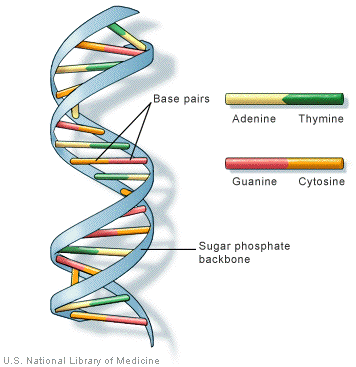
        The DNA molecule has been likened to two intertwined spiral staircases — and the metaphor works well up to a point. The four-letter code of A,T,C,G is contained on the stair steps. Where one step is an A, its matching step on the other spiral must be a T. Where one is a C, the other must be a G. However, an actual double stairway would have a central pillar to support the whole structure — and there the metaphor fails because there's no molecular equivalent. Instead the supporting "backbone" of DNA is on the outside — looking more like the handrails of the stairs. And it's here that phosphorous, alternating with what are essentially sugars, plays its essential role. In short, the substitution of arsenic for phosphorous is just a cleverly improvised feat of molecular carpentry and would not signify extraterrestrial origin to anyone with any knowledge of biochemistry.

Testing for life on Mars
       Later in the first hour, Hoagland remarked "This marks the first time NASA has grappled with the concept 'What is Life?'" That idea would certainly bring a smile to the face of any of the hundreds of NASA-contracted bioscientists who confronted that very question as the biology instruments for the Viking Mars landers were being designed in the early 1970s. The question defies any easy answer — in fact, the Viking biology group never really made up its collective mind, instead sending three separate instruments each with its own assumption about the sine qua non of Life. It's also worth noting that some people — including Hoagland himself, as it happens — think that, even with 2 belts and one pair of braces, Viking's trousers still fell down.

The numerology of the space shuttle
        In the second hour Hoagland took off into the unintentionally comic territory of numerology. I found it hard to follow — it appeared to incorporate a strange form of mathematics in which the numbers 33 and 133 are identical. It came as no surprise, though, that he wanted to make something ritualistic of the fact that the atomic number of arsenic is 33. That's right, Richard — the sinister Masonic conspiracy within NASA reached back across 100 years of history to dump arsenic in Mono Lake for just that reason. Yeah, man.

        I did sort-of follow his next proposition — namely, that the still-upcoming STS-133 space shuttle mission is the first "post-Newtonian" mission. This means, according to Hoaglandian logic, that the energy needed to get the shuttle to orbit will come, not from old-fashioned rocket fuel, but from "hyperdimensional space, torsion physics, and etc. etc. etc." I'm sure this comes as a surprise to everybody involved in the mission.

        A classic Hoaglandian performance, ending with — guess what? — an 800 number that will put cash in the Hoagland pocket.

Way to go, Coast.

Update 1:
Two criticisms of the experiment from biochemists have now surfaced in the blogosphere. Both seem quite harsh.

Rosie Redfield
Alex Bradley

Although it might be entertaining to watch the biochemists slug it out in blogs, you can bet that isn't going to happen. It's just not dignified for the lead author of a paper in a peer-reviewed journal to respond to informal critiques.

Update 2:
Well, surprise—there is now a response from Dr Wolfe-Simon, although not in a blog or a tweet.

Update 3:
STS-133 went from ground to orbit powered by LH2/LO2, just as normal.