Showing posts with label carl sagan. Show all posts

Sunday, December 18, 2016

Christmas, Carl Sagan, and extraterrestrials

        At this festive season, what topic could be more appropriate for this blog than Carl Sagan's 1977 Christmas lectures at the Royal Institution in London?

        In my previous blogpost I insisted that Carl Sagan may have theorized a possible 10,000 visits to Earth by ETs in his 1962 paper, but he certainly did not hold that opinion for very long. I made reference to his Christmas lectures for support of that proposition, and I'm about to give chapter and verse on that.

        The overall title of the six-lecture series was "The Planets," and it was Carl Sagan at his best--urbane, charming, fluent and full of good information. The R.I. demonstrators were at their best too, providing excellent models and other visual aids to make this sometimes difficult subject accessible. In the last lecture, titled Planetary Systems Beyond our Sun, Sagan started by talking about techniques for detecting exoplanets. Today those techniques have been refined but the general principles are still the same. He talked about the Drake equation, as a way of estimating how many intelligent civilizations there are in the galaxy, and then embarked on an analysis of how radio contact might be established. This included an intriguing demonstration of how a three-dimensional model of a formaldehyde molecule might be transmitted as a message of 29,791 binary digits. The intent of such a message, he said, might be to direct our attention to the natural frequency of formaldehyde where a more elaborate message would be found. He then went on to say this:

47:55 One often comes upon some other ideas about extraterrestrial intelligence -- namely, why go to all this trouble with radio telescopes when the extraterrestrials are already here? We sometimes hear something like that. The ideas are often expressed in terms of unidentified flying objects, and in terms of ancient astronauts. Now there's nothing silly about being able to fly between the stars. We are already doing it although at an extremely slow pace. It's taking us about 80,000 years to go from here to the nearest star with our present space vehicles. But other civilizations more advanced than we might very well be able to do it in much shorter periods of time--so maybe we are, or have been, visited. It's not ridiculous. On the other hand, it's such an important contention that we should demand only the most rigorous standard of evidence. And my judgement is that on the ancient astronaut business what happens is people look at big buildings constructed long ago and say "My goodness, I don't know how that big building was built, probably people from somewhere else built it." Yes--maybe from Egypt, but not from some other star. These ideas often show an ignorance of archaeology--our ancestors were smart, they could build big. There's no artifact in early human history, so far as I know, which requires extraterrestrial intervention.

Likewise, on unidentified flying objects, there are things seen in the sky which are unidentified--that's what an unidentified flying object is, it means we don't know what it is. It doesn't mean it's a space vehicle from somewhere else. And there ought to be things in the sky that we don't understand--the sky is very rich in phenomena--astronomical, meteorological, optical and man-made phenomena. And therefore only a very reliable sighting of an extremely exotic object ought to be considered in any way relevant to our problem of life elsewhere.  And to the best of my knowledge, there are lots of exotic reports, but none of those exotic reports are reliable. For example, a 30-foot diameter metallic shaped object lands in a suburban garden. A seamless door opens. A metallic robot walks out, picks a flower, smells it, pets the cat, waves to a lady hiding behind her sliding glass door, turns on his heel, enters the UFO, the seamless door closes and it takes off into space. Now that I would call an exotic story--no question about it. But when we look closely into that, it turns out no-one in all of Long Island, New York City, besides the old lady noticed that this had happened. And the cat was unavailable for corroborative evidence.  And that's an example of an exotic story that isn't reliable. On the other hand there are reliable stories, lots of people see something, that are not exotic--a light in the sky. There are no cases where 200 people see something as exotic as what I just said, no cases where there's a piece of the spacecraft that someone captures and sneaks into a laboratory so they can investigate it. No-one has ever managed to steal the captain's log book. And until that sort of thing happens, it seems to me we must be very cautious and skeptical because extraordinary claims require extraordinary evidence. It would save us a lot of trouble if those fellows  would come here, instead of us having to go out and find them. I'm not opposed to it--it's just that there isn't a smidgen of good evidence to support those ideas. I wish it were otherwise. 
It's very unlikely I'll be blogging again until 2017, so best wishes to all.

Wednesday, April 29, 2015

Richard Hoagland's 70th birthday numerology

        It was Richard Hoagland's seventieth birthday last Saturday, and the occasion was marked publicly by yet another two-hour radio interview. Not on Coast to Coast AM, as I'm sure he would have preferred, but on a two-bit internet podcast associated with that madman David Icke. The interviewer was not Icke, but a bloke with a comedy Irish accent by name of Richie Allen.

        We got into numerology immediately, as Allen asked Hoagland how it felt to be 70, and Hoagland replied that, as 70 = 10 x 7, and seven is an important number in hyperdimensional physics (Eh??? Important how??), that must mean that great things are about to happen in the field he's been researching for 35 years. Oh yes, Great Things About To Happen. Where have we heard that before?

        Then it turned into a name-droppathon, as he reviewed his brilliant career. Walter Cronkite, Arthur C. Clarke, Carl Sagan, Isaac Azimov, Margaret Mead and Jules Bergman all got their name-checks. We heard again how he was responsible for naming the first Space Shuttle Enterprise (except he wasn't -- the letter-writing campaign was organized by Betty Trimble) and how he unearthed the Brookings Report and its cautionary message to NASA (except he didn't --  Don Ecker and Lee Clinton did.) Well, I suppose you can't really blame an old man for reminiscing about the far-off days when he actually had a job and was doing something useful.

About the Brookings Report,note 1 his wrap-up was as follows:
42:55 "For the next 50 years -- from the time of its inception in 58 -- NASA has steadfastly denied any and all evidence that they've ever detected anything that would even hint at the possibility of living organisms anywhere in the solar system."
        This is to ignore the hundreds of  scientific papers published by NASA scientists on Martian water, organics, and methane. I know it's fashionable to denigrate Wikipedia (often for good reasons, it must be said), but the wiki-article on Life on Mars is pretty good. It includes the sentence "The search for evidence of habitability, taphonomy (related to fossils), and organic carbon on the planet Mars is now a primary NASA objective." Hoagland is simply wrong.

Fantasy-land
"I'm a data-driven guy. I don't make claims -- regardless of what  my acerbic and over-the-top critics say all the time, because it's disinformation. I try to stick to facts -- I try to stick to things which you can independently verify. I try to stick to official sources, and official data. What I don't do is to pay a lot of attention to leaks."
        That was Hoagland, at 1:29:20 into the interview. Oh, how we acerbic critics wish it were true. But at 1:42:00 we got this astounding piece of flim-flam: Absolutely classic Hoagland.
"What's the one thing that would change everything on this planet? If we were to go to the Moon and bring back high technology. Absolutely tons of stuff are preserved underground. Don't look at the cratered surface -- think 200ft, 1000ft, a mile down, two miles down. There's obviously (emph. added) a ton of stuff in perfect preservation, particularly if it's been exposed to a vacuum. You bring that stuff back, you back-engineer it, you create electronics, you create power supplies, you create medicines, you create solutions for all kinds of intractable diseases, like cancer for instance -- that have already been worked on and perfected by the guys who went before us, who are part of the human family. We're not talking about aliens, we're talking about the human race, just a lot older and a lot more incredible than we've been allowed to believe up until just yesterday. And you do all that in the private sector. Not only would Musk make billions and billions and billions more, but he changes the direction of the planet for the better. And that's why Elon Musk must succeed, and all the other private guys must succeed--because they ... are the keys to the kingdom, the keys to the future of the human race, and the keys to the transformation of this planet from the hell it is for most people to the Garden of Eden it could be again if this information was made freely and publicly available."
        Not at all a bad speech, especially as it was totally off-the-cuff. However, it's pure fantasy, of course. I wish I had Hoagland's eloquence, but I'm glad I don't have his self-delusion.

Many happy returns, Richard.

=================================
[1] If any readers don't know what "The Brookings Report" refers to, here's a briefing.

Tuesday, January 6, 2015

The hollow Moon, and the brain of Rob Shelsky

         If you want to do any kind of successful spaceflight operation on, or near, the Moon, you absolutely need to know some facts about it. If you need to orbit it, land on it, and/or take off from it, the primary data you need are:

- Mass
- Diameter

        Once you have those two, it's a simple matter to figure out how much lunar gravity is available to keep your spacecraft in orbit, hold down your lander and maybe your astronauts, and resist your attempt to escape from it to get back home.  Well, NASA has done some pretty successful stunts up there over the years—not just Apollo but many photographic and scientific orbiters. The Russians have had their successes with the Luna and Lunakhod missions. The Chinese have Chang'e and the Jade Rabbit lander—the Indians have two Chandrayaan landers to their credit.

        So I can tell you with 100% confidence that we know how big the Moon is and how heavy it is. Here's the data:

- Mass 7.35 x 10²² kg
- Diameter (mean) 3474 km

        Since the volume of a sphere is given by 4πr3/3, it's a trivial matter to calculate:

- Volume 2.2 x 10¹⁹ cubic metres

...and from that...

- Density 3340 kg/m3 (since density = mass divided by volume)


More rubbish from George Noory
        I mention this—and I repeat, this data is not guesswork but certainty—because Coast to Coast AM last night donated three hours of broadcast time to an ignoramus called Rob Shelsky. Shelsky is described as an investigative journalist. His proposition was that the Moon is hollow, and he wanted us to know that there were three pieces of evidence for this idea. The first of them was that the overall density of the Moon was much less than it could be expected to be if the whole thing was solid.

        Well now, that's quite an easy factoid to check, now that we know with certainty what that density is. We happen to have, down here on Earth, 382 kg of moon rocks from Apollo, 326 grams from Luna, plus a few bits from meteorites. We can measure their density and see if the density of the whole Moon really is a surprise. People in white coats and face masks have indeed done that, and here's what they found:note 1

Mare basalts: 3270 - 3460 kg/m3
Feldspathic highlands rocks: 2510 - 2840 kg/m3
Breccias: 2360 - 2520 kg/m3

        We can pretty much forget the breccias because by definition they are highly porous — full of air (actually vacuum, since this is the Moon.)  Then once we realize that most of the Moon is basalt, the conclusion must be that there is no reason at all to think that the Moon is hollow on the basis of its density.

        The investigative Mr. Shelsky was perhaps misled by the fact that the overall density of the Moon is only six-tenths that of Earth. But that's because the Moon lacks that really heavy iron core that is siting there under our feet, giving us weight in addition to our inherent mass.

Like a bell
        The second part of Shelsky's "evidence" was that, when Apollo 13's SIVB upper rocket stage was deliberately crashed into the Moon, the seismometer left there by the Apollo 12 crew reacted and went on reacting for more than 10 minutes. Clive Neal, associate professor of civil engineering and geological sciences at the University of Notre Dame, entered the annals of sound-bite history by remarking that the Moon "rang like a bell." However, that has more to do with the Moon's perfect dryness than its inherent musicalitynote 2. It is not credible evidence for the hollow Moon.

Sagan
        Finally, the ill-informed Mr. Shelsky told us that even the Great Carl Sagan thought that maybe the Moon was hollow, and his co-author Ivan Shklovskii agreed. Shelsky cites Shklovskii—try saying that 12 times quickly. Wrongly, as it turns out. The booknote 3 he's thinking of speculated that Phobos, the moon of Mars, might be partly hollow. That was based on orbital data available at the time which has since been discredited. Now the error-prone Richard Hoagland is the only person who thinks Phobos is hollow, and even he would scoff at Shelsky's pseudo-data.

       Would somebody please tell George Noory and Lisa Lyon, his Exec. Producer, to stop misinforming their audience? Thank you.

==============================
[1] Kiefer, W. S., Macke, R. J., Britt, D. T., Irving, A. J., and Consolmagno, G. J. (2012) The Density and Porosity of Lunar Rocks. Geophysical Research Letters, v. 39, L07201, doi: 10.1029/2012GL051319.

[2] http://www.nasa.gov/exploration/home/15mar_moonquakes_prt.htm

[3] Sagan, Carl, and Shklovskii, I.S. (1966) Intelligent Life In the Universe. Dell. ISBN-13: 978-0440540564

Friday, June 8, 2012

Frantic fun in Facebooklandia

        More kudos to Irene Gardner, for a very daring raid on Hoagland's smug arrogance yesterday, which included these words:
"You are a liar Hoagland. YES THAT IS LIBEL. Take me to court you bastard."
        I <3 it. I've preserved the entire text plus the 67 comments it attracted. It even brought the notorious Max Kiejzik out of the psychiatric hospital to peddle his ridiculous pseudo-geometry for the 5,000th time. Hoagland himself must be in one of his periodic attention-lapses, because Irene's bold challenge has been allowed to remain for nearly 24 hours now.

        Then today, courtesy of Esteban Navarro Galán, we got this treat:

image credit: icanhazcheeseburger

        Well, not that exactly, but something related. You know how Richard Hoagland never tires of reminding us that he and Carl Sagan were such good buddies they were practically a mutual admiration society? Well, Esteban dug up a quote from Sagan which cast some doubt on that. Sagan gave a keynote address at the CSICOP Conference in Seattle, Washington, June 23—26, 1994. This was just three weeks after Hoagland's lecture at Ohio State, which this blog has referred to. He took questions, and this was one of them:
Richard Hoagland has recently got hold of some pictures, Hasselblad pictures from NASA, which were taken some twenty years ago of the moon, and he has been describing those in great detail. He gave a talk at Ohio State University a couple of weeks ago and he had video cameras on and they were supposed to have videos available. I wonder if you’ve heard about this and had previous knowledge of...
Sagan responded:
Richard Hoagland is a fabulist. By the way, it’s not difficult getting hold of the hand-held Hasselblad camera pictures; NASA freely releases them to everybody. ...The aspect of this story I know best has to do with the so-called Face on Mars. There is a place on Mars called Cydonia, which was photographed in a mission I was deeply involved in, the Viking mission to Mars in 1976. And there is one picture in which along a range of hulking mesas and hillocks, there is what looks very much like a face, about three kilometers across at the base and a kilometer high. It’s flat on the ground, looking up. It has a helmet or a hair-do, depending on how you look at it, it has a nose, a forehead, one eye—the other half is in shadow—pretty eerie looking. You could almost imagine it was done by Praxiteles on a monumental scale. And this gentleman deduces from this that there was a race of ancient Martians. He has dated them, he purports to have deduced when they were around, and it was 500,000 years ago or something like that, when our ancestors were certainly not able to do space flights, and then all sorts of wonderful conclusions are deduced and “we came from Mars”or “guys from other star systems came here and left a statue on Mars and left some of them on Earth.” By the way, all of which fails to explain how it is that humans share 99.6 percent of their active genes with chimpanzees. If we were just dropped here, how come we’re so closely related to them? What is the basis of the argument? How good is it? My standard way of approaching this is to point out that there is an eggplant that looks exactly like former President Richard Nixon. The eggplant has this ski nose and, “that’s Richard Nixon, I’d know him anywhere.”
What shall we deduce from this eggplant phenomenon? Extraterrestrials messing with our eggplants? A miracle? God is talking to us through the eggplant? Or, that there have been tens, hundreds of thousands, millions of eggplants in history, and they all have funny little knobs, and every now and then there is going to be one that by accident looks like a human face. ... I think clearly the latter. Now let’s go to Mars. Thousands of low, hilly mesas have all sorts of features. Here’s one that looks a little like a human face. When you bring out the contrast in the shadowed area it doesn’t look as good. Now, we’re very good at picking out human faces. We have so many of these blocky mesas. Is it really a compelling sign of extraterrestrial intelligence that there’s one that looks a little like a human face? I think not. But I don’t blame people who are going into the NASA archives and trying to find things there; that is in the scientific spirit. I don’t blame people who are trying to find signs of extraterrestrial intelligence—I think it’s a good idea, in fact. But I do object to people who consider shoddy and insufficient evidence as compelling.
        Bravo, Sagan. As clear and convincing as ever. And Gracias, Esteban, for finding it.

         A Hoagland disciple called Val Williams, evidently outraged, posted "Don't bother reading......SMEAR CAMPAIGN!!! aka 'INFLAMING' 'BAITING'". It's not clear who Val thought was doing the smearing —Sagan or Galán. If any more similarly craven or intolerant comments turn up, I'll add them.

Update:
        I think we're done with the thread. It's still there but so far down the scroll-mountain that nobody's going to find it. Here's the final comment, from Max Kiejzik—not so much craven as all too self-revealing:
 Is it the ~crazy train~
Or the *LOGIC TRAIN*
Decide for YOURSELF.
ALL ABOARD!!!!! Ha ha ha ha ha ha haaaa! Ay, Ay, Ay, Ay, Ay, Ay, Ay...
:)

Friday, December 3, 2010

Tiny bacterium defeats pseudoscientist


        Last night, in a spectacular display of superhuman ignorance, Richard Hoagland managed to ask the wrongest possible question about arsenic substitution in biochemistry, and then capped it by coming up with the most ridiculous possible answer. He wondered aloud to his radio audience of millions why none of the journalists at the afternoon's NASA press conference had asked whether the extremophile bacterium GFAJ-1 came from an extraterrestrial source, and declared that to him the answer was obvious — yes, of course it did. "There is an alien in our midst," he said theatrically.

        To recap, for those who did not follow the day's events, the NASA astrobiology program called the conference to announce a very unusual finding. Geomicrobiologist (and, it turns out, accomplished oboist) Felisa Wolfe-Simon, a rather fetching tousle-haired nerd's dream-girl, took the credit for the discovery that, in conditions of restricted environmental phosphorous, GFAJ-1 can use arsenic instead, in building the DNA backbone upon which it depends to function. Wolfe-Simon had theorized that this might be possible, and had gone to Mono Lake in a successful search for proof.

        It was a pretty brilliant piece of work by Dr Wolfe-Simon, and it took an intellect as puny as that of Richard C. Hoagland to misunderstand it quite that thoroughly.

A nearly toxic lake


        Mono Lake, a couple of hundred miles East of San Francisco, is a natural chemistry experiment gone awry. Indifferent water management over the centuries has made it highly saline and unusually alkaline, and mine tailings from the California gold rush have bequeathed it near-toxic levels of arsenic. Yet gamma-proteobacteria like GFAJ-1 have found a way to make a living there.

        It's one of the best-established principles of evolution that organisms adapt to their environment. If the environment places stress on a population — say by getting hotter, drier, or more acidic — the population is selected for those individuals that tolerate the stress best. Over time, the population either fails to adapt and dies out, or develops a new strain that finds the environment congenial. Well, lo and behold, as Lake Mono became deficient in phosphorous and oversupplied with arsenic, the plucky little bacterium found a way of making do. High arsenic = arsenic-tolerant bacteria. Simple, really. So for Richard Hoagland, with no knowledge of biochemistry whatsoever, to ask which distant galaxy might have seeded the lake with GFAJ-1 is like him finding an apple on the ground under an apple tree and saying "Hmmm, wonder where that came from?"

Sagan misquoted
        We did not have to wait long, either, before Hoagland's attempts to justify his error led him deeper into the jungle of misunderstanding. He quoted Carl Sagan to the effect that a different form of DNA would be the hallmark of an extraterrestrial organism. What Sagan actually said was that a different DNA code would be the hallmark. That's a crucially different proposition, because phosphorous (or in the present case, arsenic) takes no part in the genetic code that is DNA's primary business.


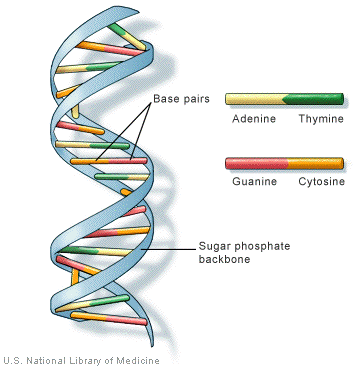
        The DNA molecule has been likened to two intertwined spiral staircases — and the metaphor works well up to a point. The four-letter code of A,T,C,G is contained on the stair steps. Where one step is an A, its matching step on the other spiral must be a T. Where one is a C, the other must be a G. However, an actual double stairway would have a central pillar to support the whole structure — and there the metaphor fails because there's no molecular equivalent. Instead the supporting "backbone" of DNA is on the outside — looking more like the handrails of the stairs. And it's here that phosphorous, alternating with what are essentially sugars, plays its essential role. In short, the substitution of arsenic for phosphorous is just a cleverly improvised feat of molecular carpentry and would not signify extraterrestrial origin to anyone with any knowledge of biochemistry.

Testing for life on Mars
       Later in the first hour, Hoagland remarked "This marks the first time NASA has grappled with the concept 'What is Life?'" That idea would certainly bring a smile to the face of any of the hundreds of NASA-contracted bioscientists who confronted that very question as the biology instruments for the Viking Mars landers were being designed in the early 1970s. The question defies any easy answer — in fact, the Viking biology group never really made up its collective mind, instead sending three separate instruments each with its own assumption about the sine qua non of Life. It's also worth noting that some people — including Hoagland himself, as it happens — think that, even with 2 belts and one pair of braces, Viking's trousers still fell down.

The numerology of the space shuttle
        In the second hour Hoagland took off into the unintentionally comic territory of numerology. I found it hard to follow — it appeared to incorporate a strange form of mathematics in which the numbers 33 and 133 are identical. It came as no surprise, though, that he wanted to make something ritualistic of the fact that the atomic number of arsenic is 33. That's right, Richard — the sinister Masonic conspiracy within NASA reached back across 100 years of history to dump arsenic in Mono Lake for just that reason. Yeah, man.

        I did sort-of follow his next proposition — namely, that the still-upcoming STS-133 space shuttle mission is the first "post-Newtonian" mission. This means, according to Hoaglandian logic, that the energy needed to get the shuttle to orbit will come, not from old-fashioned rocket fuel, but from "hyperdimensional space, torsion physics, and etc. etc. etc." I'm sure this comes as a surprise to everybody involved in the mission.

        A classic Hoaglandian performance, ending with — guess what? — an 800 number that will put cash in the Hoagland pocket.

Way to go, Coast.

Update 1:
Two criticisms of the experiment from biochemists have now surfaced in the blogosphere. Both seem quite harsh.

Rosie Redfield
Alex Bradley

Although it might be entertaining to watch the biochemists slug it out in blogs, you can bet that isn't going to happen. It's just not dignified for the lead author of a paper in a peer-reviewed journal to respond to informal critiques.

Update 2:
Well, surprise—there is now a response from Dr Wolfe-Simon, although not in a blog or a tweet.

Update 3:
STS-133 went from ground to orbit powered by LH2/LO2, just as normal.