He did, however, jump in when somebody in the audience asked about the mysterious right-angle feature on the Moon. This was first noticed by a vlogger called wowforreeel, then reported by HuffPo. It's the same one Stuart Robbins asked me about when he interviewed me for his 100th podcast. Here's the image wowforreeel noticed:
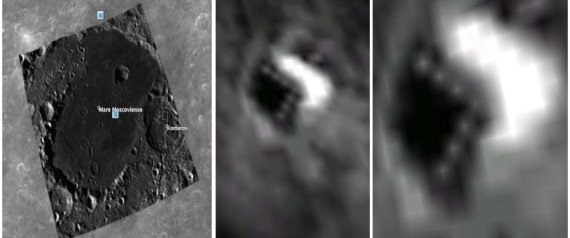
Now here's the crater as seen by Lunar Reconnaissance Orbiter's narrow angle camera. The sun angle is almost the opposite of what it was for the Google Moon image.

Here it is with brightness reduced and contrast boosted a bit.

It's at 22.6900°N, 142.6134°E and here's a permalink to the LRO map.
In his remarks, Mike Bara got just about everything wrong as usual. It starts at 12:55 on this video.
"Yeah, it's interesting. They're pixel artifacts I think at this point. They're digital artifacts from the way Google Moon compresses everything. But it's really interesting because if you look at that crater, that crater actually has -- if you look at high-resolution pictures of it -- it actually has, like, a chevron type shape. To me it's a chevron shape, right? It has that embedded in it and that's really unusual because the reality is, every crater on the Moon should be circular. How do you get that? Oh they have all these complex theories about the underlying bedrock -- you know, cooled in a certain way, but it just doesn't... it looks a little weird. It looks like there's some weird stuff going on there, and you've gotta understand... this is the back side, where I found some really interesting stuff, and also the fact is is that what they... They have limited resources on all these orbiters. So if they're taking really high resolution images of the area -- which they did of that particular area -- Google Earth doesn't give you them, it compresses it a little bit. They were interested in something there. That's why they took the picture. I mean there's this thing... I had a big dispute with people last year, it was in Ancient Aliens on the Moon, I called it the Daedalus Ziggurat. [It] looks like a ziggurat, near the crater Daedalus on the back side of the Moon. And -- you know -- they tried to photograph it with the Mars Reconnaissance Orbiter. It's funny 'cos the guys were saying I'm full of it... I'm full of shit is what they were saying. You know, they're like "Well yeah we tried to take a picture of this area" well they missed it. Either they missed it or they didn't show us that part of the photograph, but they tried to take a picture of it, so that tells you there's something interesting there, otherwise they wouldn't be wasting the orbiter resources on it."
How doth Mike Bara err? Let me count the ways.
* The artifact is from mosaicing (also called stitching,) not compression. Update: That may not be as wrong as I thought when I first wrote it. A credible theory by Mick West (see comments below) ascribes this phenom to a badly-applied sharpening algorithm.
* The crater is not chevron-shaped.
* There is nothing "weird" about it.
* No, every crater on the Moon does not have to be circular. Craters are elongated if the angle of impact is small. Lunar terrain sometimes shifts because of volcanism. Check out this baby.
* The reference to "Mars Reconnaissance Orbiter" was a slip of the tongue, OK, no biggie.
* The problem with the so-called ziggurat is not that LRO tried to image it but missed, but that it doesn't exist. Here's the image it would have appeared on if it was there. Mike Bara's arrogance does not allow him to admit that he's wrong, so he retreats to an untenable position.
* Bara has still not explained why the "ziggurat" is not seen on the Japanese image from Selene (Kaguya).
* It is totally untrue that somebody must have had a special interest in that area "otherwise they wouldn't be wasting the orbiter resources on it." LRO is engaged in mapping the entire Moon. As long as it's in orbit, no additional resources are needed to capture images. That applies equally to the "ziggurat" and the "mystery right-angle" (which by the way is 96° not 90.) Huge swaths of boring, featureless, lunar real estate have been photographed at a resolution of 0.5 metres/pixel.
