I was recently re-reading your May 1997 essay "Where is the informed criticism of Richard Hoagland?" I note this sentence, toward the end:
"If Hoagland is wrong then let him be proved wrong. Let the critics who doubt the quality of his work repeat the process, and find him in error."
I have now done that, in relation to:
- The mythical anti-gravity boost to Explorer 1. His calculation is totally in error.
- The photo-processing of the rock called "data's head". His processing was found to be fraudulent.
- Neil Armstrong's 25th anniversary speech. Armstrong actually said the OPPOSITE of what Hoagland claims he said. You have conceded this.
- The allegation that Apollo astronauts actually returned artifacts of a lunar civilisation. You have conceded that there is no evidence of that.
- His characterisation of the Brookings Report as "strongly recommending" concealment of evidence of alien life. It did not.
James Oberg has falsified your allegations of sabotage in respect of Mars Observer, Mars Polar Lander, and Mars Climate Orbiter.
Are you now going to withdraw the 1997 essay?
Wednesday, September 10, 2008
Informed criticism? Yeah — we got that
Mike Bara censored the following post today, disallowing its appearance on the official "Dark Mission" blog in its entirety:

Monday, August 25, 2008
New calculations even more fatal to Hoagland's latest crackpot theory (Updated 8/29)
The following post to the "Dark Mission" blog was censored today. Bear in mind that, on his horrible web site, Hoagland seeks to prove that the 600 ft/sec velocity surplus at orbit insertion of Explorer 1 was too great to be explained by over-performance of the solid rocket stages. In the equations, g is the acceleration due to gravity in ft/sec2, Isp is the specific impulse of the stage in seconds, and Wi is the initial mass of the stage plus its fuel and whatever else it is carrying. dV is the increase in velocity provided by the stage.
There's another, possibly simpler, way of looking at this. Since the parameters of the elliptical orbit are precisely known, the orbit velocity can be calculated from a reliable equation. Deduct the burnout velocity of the first stage -- also known, but with less precision -- and what's left is the dV of the solid upper stages. Calculations done this way were offered to the "Dark Mission" blog, but blocked. Hoagland and Bara accept nothing that challenges their ridiculous and misguided ideas.
There's a small discrepancy between the two calculations, to be sure -- due to uncertainty about the velocity at first-stage burnout, perhaps.
Other factors that would be considered in a really accurate calculation:
* Correction to the value of g as the rocket ascends away from Earth -- a small positive vertical increment
* Boost given by rotation of Earth -- separately calculated as 1100 ft/sec horizontal
* Gravity drag -- perhaps negative 1000 ft/sec vertical
However, the discrepancy is nothing to compare with the difference between 14,000 and 3,520.
Somebody with more skill at rocket-science than me has provided an even more ferocious condemnation of Richard Hoagland's faulty mathematics in attempting to calculate the velocity addition of Stages 2,3 and 4 of Explorer 1.
He points out that, using Hoagland's notation, Konstantin Tsiolkovsky's rocket equation is normally written as:
dV = g x Isp x ln(Wi/Wf)
where Wf is the final mass at burnout (but before discarding the burnt-out stage)
He then points out that it's not permissible to aggregate the stages and evaluate the equation once. You are obliged to take it stage by stage, and this is his result:
STAGE 2
----------
Wi = 1020+280+80
= 1380
Wf = 1380 - 530 (weight of the burned fuel)
= 850
dV = 32.2 x 220 x ln(1380/850)
= 7084 x 0.482
= 3,414 ft/sec
STAGE 3
------------
Wi = 280+80
= 360
Wf = 360 - 140 (weight of the burned fuel)
= 220
dV = 32.2 x 235 x ln(360/220)
= 7567 x 0.492
= 3,723 ft/sec
STAGE 4
-----------
Wi = 80
Wf = 80 - 48.5 (weight of the burned fuel)
= 31.5
dV = 32.2 x 235 x ln(80/31.5)
= 7567 x 0.932
= 7,052 ft/sec
TOTAL delta-V
---------------------
3414 + 3723 + 7052 = 14,189 ft/sec
An additional 600 ft/sec represents 4.2% over-performance.
There is no need to resort to an anti-gravity field to account for this. Hoagland's entire thesis is therefore falsified. Cheers.
There's another, possibly simpler, way of looking at this. Since the parameters of the elliptical orbit are precisely known, the orbit velocity can be calculated from a reliable equation. Deduct the burnout velocity of the first stage -- also known, but with less precision -- and what's left is the dV of the solid upper stages. Calculations done this way were offered to the "Dark Mission" blog, but blocked. Hoagland and Bara accept nothing that challenges their ridiculous and misguided ideas.
Richard Hoagland writes that the solid upper stages of the Juno 1 rocket that launched Explorer 1 only contributed 3,520 ft/sec of the total orbital injection velocity. Well, let's see now...
DATA:
Planned orbit 220 x 1,000 miles (352 x 1,600 kM)
Actual orbit 223 x 1,592 miles (357 x 2,547 kM)
Radius of Earth 6,375 kM
Gravitational constant, µ, of Earth 398,660 kM3/s2
Cut-off velocity of Jupiter-C rocket (Juno's liquid first stage) 9,020 mph = 13,229 ft/sec [1]
CALCULATION:
semi-major axis of actual orbit, Lsmaj, (357+6375+6375+2547)/2 = 7827 kM
distance from center of Earth to orbit point, R, 6375+357 = 6732 kM
velocity at orbit injection, Vorb = √(µ(2/R - 1/Lsmaj)) [2]
2/R - 1/Lsmaj = 0.000169
Vorb = √67.493 = 8.215 kM/sec = 27,111 ft/sec (actually only 2.5% greater than planned)
less the velocity achieved by the first stage: 13,229 ft/sec
Ladies and gentlemen, get out your calculators! In about 3 seonds you will falsify Hoagland's entire theory.
[1] http://www.astronautix.com/lvs/jupiter.htm
[2] http://en.wikipedia.org/wiki/Orbital_velocity
There's a small discrepancy between the two calculations, to be sure -- due to uncertainty about the velocity at first-stage burnout, perhaps.
Other factors that would be considered in a really accurate calculation:
* Correction to the value of g as the rocket ascends away from Earth -- a small positive vertical increment
* Boost given by rotation of Earth -- separately calculated as 1100 ft/sec horizontal
* Gravity drag -- perhaps negative 1000 ft/sec vertical
However, the discrepancy is nothing to compare with the difference between 14,000 and 3,520.
Saturday, August 23, 2008
Hoagland's new crackpot theory defeated by his lousy math
The latest buffoonery from Richard Hoagland is a treatise in three laborious parts on an anti-gravity field allegedly discovered at the launch of Explorer 1 fifty years ago, and then kept secret until now. Mike Bara posted on the topic recently, somewhat lamenting the fact that, in an error-filled four-hour marathon on "Coast to Coast AM", Hoagland had pre-empted their plan to reveal this deep-dark-secret in a future edition of "Dark Mission". My response was censored and not permitted to appear:
If Hoagland/Bara do decide to publish this stuff, despite the elementary mathematical errors, it's a safe bet the publisher, Adam Parfrey, won't notice. He doesn't understand simple everyday logic, certainly not complicated stuff like arithmetic.
In his radio appearance Hoagland triumphantly declared victory over his critics, noting that none of them has e-mailed messages along the lines of "Hoagland Blows It Again". Richard, you may now eat them words.
>>Oh well. It is truly amazing stuff. You guys' heads will explode.<<
Explode with laughter, possibly. Hardly for Hoagland's logic or for his mathematical skill.
Turning first to his logic, what he alleges happened to the Explorer and Vanguard series must obviously have also happened to any spin-stabilised satellite launch. Now, I don't exactly know how many spin-stabilised satellites have been launched in the last 50 years, but it's a lot. Hoagland wants us to believe that an important factor affecting the final orbit insertion velocity of these satellites remained unknown to the engineers whose responsibility it was to calculate rocket ascent profiles. Unknown because it was declared secret "at the highest levels of government".
I say.... Nonsense.
Now to the math.
The equation Hoagland presents for deriving dV, the velocity added to the rocket by stages 2,3,4, in ft/sec, is as follows:
dV = -g*ISP*ln(1- Wp/Wi)
where
g = accel. due to gravity (ft sec-2)
ISP = specific impulse (sec)
Wp = weight of propellant burnt (lb)
Wi = initial weight of vehicle (lb)
He then inserts figures to get:
dV = -32.2 x 228 x (662lb/1380lb) = 3520 ft/sec
If I were his mathematics tutor, I'd give him an F for that.
By his own figures, from the Smithsonian, total weight of the three stages = 1020 + 280 + 80 = 1380, correct
Empty weight = 490 + 140 + 31.5 = 661.5
Therefore weight of propellant burnt = 1380 - 661.5 = 718.5, NOT 662.
If we accept his equation, the value of dV is 5389, not 3520. Hoagland appears to have forgotten to derive the natural logarithm.
[calculations re-done correctly in aug 25th post on this blog]
Maybe you guys should think again about using this garbage in a future edition of "Dark Mission".
If Hoagland/Bara do decide to publish this stuff, despite the elementary mathematical errors, it's a safe bet the publisher, Adam Parfrey, won't notice. He doesn't understand simple everyday logic, certainly not complicated stuff like arithmetic.
In his radio appearance Hoagland triumphantly declared victory over his critics, noting that none of them has e-mailed messages along the lines of "Hoagland Blows It Again". Richard, you may now eat them words.
Monday, August 18, 2008
Hoagland & Bara wrong as usual
The destruction, last February 21st, of the crippled military satellite USA193, was the occasion for more errors by H&B. Ever alert for the appearance of what they call the "ritual numbers" 19.5 and 33 in space affairs, Mike Bara posted on that day a totally erroneous claim that the navy ship that launched the fatal missile was at 19.5°N latitude, as was Sec. Def. Robert Gates when he made the announcement that the mission was going ahead. Similar erroneous material appeared on Hoagland's unreadable web site. As I pointed out at the time, the exact location of the ship was not known but it was announced as north of Hawaii, and therefore above 22°13'. Gates was in Honolulu, at 21°18'. Overall control of the operation was from Omaha, at 41°15' N.
A commenter on the official "Dark Mission" blog returned to this topic on August 10th, posting links to some new comments (also some not-so-new, like James Oberg's analysis in "Spectrum"). My additional comment was, of course, censored and not permitted to appear on the blog.
A commenter on the official "Dark Mission" blog returned to this topic on August 10th, posting links to some new comments (also some not-so-new, like James Oberg's analysis in "Spectrum"). My additional comment was, of course, censored and not permitted to appear on the blog.
LEST WE FORGET:
Richard Hoagland, commenting on the destruction of USA193 on 'Coast to Coast AM' stated that he was sceptical, because the Columbia space shuttle contained more hydrazine than the spy satellite when it disintegrated, and no concern about toxicity was expressed at that time.
This, of course, was completely wrong on both counts. A typical performance from the program's so-called 'science advisor' who makes errors every time he appears on that wretched radio show. Its producers are evidently too clueless to know the difference between a scientist and a buffoon.
Friday, August 8, 2008
Another "stunning confirmation"?
Undoubtedly Richard Hoagland's favorite adjective is "stunning", and one of his very favorite uses of it is in the phrase "In a stunning confirmation of [insert one of his crackpot theories], newly published results... bla bla bla".
A classic example was the 25th June post on the darkmission blog, headed "New Study Confirms More Aspects of Mars Tidal Model". This referred to computer modelling at UC Santa Cruz, suggesting that historically Mars suffered a colossal impact with an asteroid about half the size of the moon. Mike Bara claimed confirmation of the so-called "tidal model" despite the fact that:
Now comes the latest of these hilariously false claims: "New Research Reinforces Key Aspects of Hyperdimensional Physics", posted on 6th August. The peg was a paper in a journal of the Astronomical Society of Australia suggesting a spin-orbit coupling between the sun and the giant planets, accounting for some features of the sunspot cycle.
Bara wrote that this is "a flat-out, indisputable confirmation of the Hoagland\Torun Hyperdimensional Physics model", although, of course, it is nothing of the kind. He also wrote that, at solar max, " sunspots, solar flares and coronal mass ejections, ... tend to cluster around the tetrahedral 19.5° latitude".
The following blog-comment was censored, and not allowed to appear:
A classic example was the 25th June post on the darkmission blog, headed "New Study Confirms More Aspects of Mars Tidal Model". This referred to computer modelling at UC Santa Cruz, suggesting that historically Mars suffered a colossal impact with an asteroid about half the size of the moon. Mike Bara claimed confirmation of the so-called "tidal model" despite the fact that:
- The collision was in the opposite hemisphere
- It happened, according to the computer model, 4 billion years ago, cf. 65 million for the tidal theory
- It was a single object, whereas the tidal theory involves "splattering" of the southern hemisphere by the products of a planetary explosion.
Now comes the latest of these hilariously false claims: "New Research Reinforces Key Aspects of Hyperdimensional Physics", posted on 6th August. The peg was a paper in a journal of the Astronomical Society of Australia suggesting a spin-orbit coupling between the sun and the giant planets, accounting for some features of the sunspot cycle.
Bara wrote that this is "a flat-out, indisputable confirmation of the Hoagland\Torun Hyperdimensional Physics model", although, of course, it is nothing of the kind. He also wrote that, at solar max, " sunspots, solar flares and coronal mass ejections, ... tend to cluster around the tetrahedral 19.5° latitude".
The following blog-comment was censored, and not allowed to appear:
From the wikipedia article on Spörer's Law: "At the start of a sunspot cycle, sunspots tend to appear around 30° to 45° latitude on the Sun's surface. As the cycle progresses, sunspots appear at lower and lower latitudes, until they average 15° at solar maximum. The average latitude of sunspots then continues to drift lower, down to about 7° and then while the old sunspot cycle fades, sunspots of the new cycle start appearing at high latitudes."19.5° is, as usual, in Hoagland's imagination only.
Thursday, July 24, 2008
Testimony of the 12 moonwalkers (updated)
Very little has been heard from the 12 moonwalkers in response to Richard Hoagland's unsupported and plainly ridiculous assertions about artifacts of dead lunar civilizations, vast glass structures, and other such flim-flam. Hoagland, of course, claims -- again with no evidence whatsoever -- that they've been deliberately deprived of their memories (he doesn't say HOW). The truth is that they have nothing to say since most of the Apollo astronauts haven't even heard of Richard Hoagland, who has no reputation at all in the world of lunar science. It's a safe bet that none of them has heard of Mike Bara, who is also devoid of reputation in any field that matters.
There are a couple of exceptions, however. Buzz Aldrin knows who Hoagland is, and once devoted some of his valuable time explaining to a group of reporters that Hoagland's ideas are hogwash. Ed Mitchell once went so far as to agree to appear on 'Coast to Coast AM' with Hoagland and listen to Hoagland's reasons for believing in the vast glass domes. To nobody's surprise, Mitchell listened and then dismissed the idea as "green cheese and baloney".
Ed's been in the news this week because he flatly asserted that UFOs (or at least some of them) really are intelligent alien visitors, that the US Govt knows it and has been covering it up. That should not be news -- he said the same thing to George Noory on 'Coast to Coast AM' in September 07 (Noory replayed that interview last night, 25/26 July).
However, Mike Bara treated it as though it was news and posted on it July 24th, together with a link to a transcript of the twelve-year-old so-called Hoagland/Mitchell "debate". Fighting back the nausea, I re-read that transcript and posted four comments to the darkmission blog. Mike Bara added a few insults, as he usually does in lieu of reasoned rebuttal, and then exercised his privilege as moderator to suppress any further discussion. The full dialog was as follows:
EXPAT: Several points occur to me on re-reading that so-called "debate". I won't expound on all of them, just the most important.
1. Art Bell was a dismally poor moderator, permitting Hoagland to interrupt on numerous occasions and generally dominate the conversation.
BARA: Since it was Hoagland’s data that was the subject of the debate, his responses obviously were more extensive.
EXPAT: 2. In segment 2, Mitchell made the good point that there were "dozens" of photo-panoramas like the one Hoagland considers anomalous, and that to be at all rigorous all of them should be examined. Hoagland replies "We have two or three of those pans right now, but we don't have all of them, but we want all of them and want to do the same thing." OK -- 12 years later, I'd love to know what the result of that research has been, but I strongly doubt I'm going to find out.
BARA: The only pans that were in question were the first generation prints that Ken Johnston had. There were not “dozens” of pans on Apollo 14, and not all the missions landed in areas where there might be such ruins. What we do know is the same structures are evident on NASA’s newly published versions of these same pans, although in a degraded form, putting the lie to the idea that the ruins are a product of our enhancement processes.
EXPAT: 3. In segment 4, Hoagland's mind-boggling dishonesty strikes me, as he partially quotes from the Space Act "The administration (meaning NASA) shall be considered a defense agency of the United States." It drew a response from Mitchell that I'm sure Hoagland relished. "I'll have to admit that's an interesting bit of language." But of course, if Hoagland had been at all honest he would have completed the clause with "....for the purpose of Chapter 7, Title 35 of the US Code". As we have discussed on this blog previously, Title 35 is exclusively concerned with patent law, and Chapter 7 concerns patent applications by employees. This legal language emphatically does not mean that NASA is "a direct adjunct of DoD", and the book ("Dark Mission") should be corrected. In particular, the very first sentence in the book should be struck. It's a lie.
BARA: It’s not a lie, you’re an idiot. As we’ve discussed before, this specific language gives NASA and the DOD carte blanche to classify any “discoveries” made by NASA. They do not have to be patentable.
EXPAT: Of course they do, if they're covered by this clause. How many times do I have to type these words? TITLE 35 IS EXCLUSIVELY CONCERNED WITH PATENTS. Chapter 17 (sorry, 17 not 7) can be read here:
http://uscode.house.gov/download/pls/35C17.txt. I direct your attention to Sect. 181 in particular. All readers of this blog will, I think, understand the point.
Notwithstanding this, I wouldn't be in the least surprised if you are correct in writing that NASA has other ways of classifying anything it chooses. That does not make it a "direct adjunct of DoD", neither does it mean that "The NASA we have known for 50 years has been a lie". If Richard Hoagland was not aware of NASA's classified activities when he was consultant to CBS, he was negligent -- it's as simple as that.
BARA: The book will not be corrected, because it is correct as it is now written. Your inability to comprehend the meaning of the US Code does NOT make it a “lie” on our part.
And if Hoagland is so dishonest, why did he include the specific language you cite in the introduction to Dark Mission?
EXPAT: He was totally dishonest in the context of the Mitchell "debate", a hair less so in the Intro to "Dark Mission". The Intro nevertheless contains quite enough distortions and outright lies.
BARA: You remind me of one of my favorite U2 lyrics "It's no secret that a liar won't believe anyone else."
EXPAT: 4. In segment 2, Hoagland makes the astonishing suggestion that some in NASA management were aware of the mile-high glass domes. He says "Well, maybe you didn't [know about them], but maybe the guys that sent you there and picked the landing sites did." Just think about that. He's saying that mission planners were aware of a mile-high physical hazard in the vicinity of the landing site AND SAID NOTHING TO THE CREW??? That's so utterly preposterous, revealing such utter ignorance of mission planning, that if I were Art Bell I'd have concluded the discussion right there and said "Go to bed, Richard. We'll call if we ever need your opinions again."
BARA: Again, all you prove here is what a fool you are and how desperate you are to try and “catch” us at something.
He’s not talking about the Mission planners. He’s talking about Farouk El-Baz. The Mission planners did not pick the landing sites. Dr. El-Baz did.
EXPAT: Is that why he used the plural word "guys"?
BARA: Given that we had consulted on all this with Marvin Czarnik, a 35 year NASA veteran and mission planner, we were hardly “ignorant” of mission planning requirements.
EXPAT: I've never heard of Czarnik. Did he advise you that Apollo crews could be kept in ignorance of major hazards in the vicinity of their landing sites? If so, he's worthless.
BARA: ....But apparently you are.
EXPAT: Have you ever attended a NASA landing site review meeting? I have, although not for Apollo. I can personally assure you that hazards are a subject of discussion.
Tuesday, June 24, 2008
'Data's Head' image proved fraudulent
Background
=========
In "Dark Mission" and on his web site, Richard Hoagland makes much of a certain rock in the lunar crater called 'Shorty', which was Station 4 of EVA2, Apollo 17. Hoagland presents a retouched photograph of this rock, claiming that it is in fact a technical artifact of a lunar civilization that no longer exists. In the introduction to "Dark Mission" he writes that Apollo astronauts brought back samples of the technology of this defunct lunar civilization "for highly classified efforts at back engineering" [sic, he means reverse engineering]. While not specifically claiming that the Apollo 17 astronauts Cernan and Schmitt actually retrieved the rock from Shorty, he wrote that "they could have". I have refuted that claim previously on this blog, citing five reasons why they could not have. Hoagland's claim that it is an artifact will now be examined and tested.
Photo processing
=============
I was interested in Hoagland's photo processing steps because I had seen one of the original Apollo 17 Hasselblad frames and could not understand how the "Data's Head" jpg could have been derived from it. Since Mike Bara, on the darkmission blog, had stated that this was a process that "anybody can repeat" I asked twice for guidance on the steps necessary to get from the whole frame to the highly decorated detail image. On the first occasion Bara replied that he was "not prepared to do your homework for you", and on the second occasion he replied "you don't know anything about how images are processed." Mr. Bara is neither polite nor helpful.
The image is a 7 kb file, 361 x 291 px., containing 34,509 colors (as measured by Paint Shop Pro v7.02 on a 2 GHz Hewlett-Packard Pavilion PC)
This is the information Hoagland offered, in a December 2007 interview for 'Project Camelot':
So the "Data's Head" image was generated from two separate prints that Hoagland himself describes as "really crappy".
For my follow-up analysis, I ordered a very high definition scan from Houston Photo Imaging, a company that is trusted by the NASA photo library and can scan direct from the negative, ensuring highest possible definition. Anything but "crappy".
I don't know where Hoagland gets his count of 14 separate Hasselblad frames. Here is the complete inventory of that camera magazine -- I see the rock only on frames 21000, 21001, 21005, 21006 and 21027. I ordered frame 21000.
The scan was shipped on CD and was in tiff format, 46.1 MB, 5190 x 6175 px., 136,589 colors. It was processed as follows:
At stage 1, a rough crop was performed to isolate the skull-like rock and the feature known as "the turkey". This yielded a tiff of 564 KB, 522 x 560 px., 26,898 colors.


At stage 2, the image was rotated to match the orientation of Hoagland's image. It was discovered that Hoagland had rotated his image 45° counter-clockwise. The crop was then matched as closely as possible. The stage 2 tiff was 40 KB 181 x 145 px., 9,179 colors.
At stage 3, the image was enlarged by a factor of 2 to produce an image with the exact pixel dimensions of Hoagland's. The file was 111 KB, 18,439 colors.

For stage 4, the image was given to a trained Photoshop operator (Hoagland himself does not say what training he has had in photo enhancement. The safest assumption is 'none'.) The operator was asked to use any available image enhancement techniques to approach the style of Hoagland's manipulations. Software version was Adobe Photoshop CS2, v 9.0.2, on a 3 GHz PC running Windows XP.
- Tonality, color and contrast were altered using the 'Curves' feature. Input: 167 Output: 91.
- Shadows, midtones, and highlights were adjusted using the 'Levels' feature. Levels: 69, 1.00, 238.
The operator commented as follows:
The reference jpg is shown below, with the Hoagland original for direct comparison:


The photoshop file was 2,254 KB, 31,869 colors. The reference jpg is 60 KB, 18,907 colors. Note that this compares with the 7 kB of the Hoagland jpg, attesting to a high degree of compression (and consequently low fidelity). It's possible that a higher-quality master file was used for the book -- however, the overall quality of image repro in the book is so appalling it hardly matters.
Conclusion
=========
It is plain that Hoagland manipulated this image in ways that go far beyond what is considered legitimate image enhancement. Despite the monochrome general appearance of the moon's surface (and notwithstanding the famous orange soil that was discovered on the rim of this very crater), there is color in these images. However, the 34,509 colors of Hoagland's image bear witness to his artificial colorization. If you inspect a de-rotated version of the 'Data's Head' image, it becomes obvious that rectangular patches have been independently colorized and then re-superimposed on the frame.

It's not so obvious on the rotated version, and this may explain why he performed the rotation (which has no innocent motive that I can determine).
I do not see the "camera lenses" that he says he sees, but if they are there, they are far more likely to be the result of an imperfect superimposition of his two scans rather than anything real. Hoagland's superimposition technique is dangerous because any slight change in perspective from frame to frame can make true matching impossible.
The bright red jaw-piece that has been described as "anodized" is simply not there. It's an artifact of processing, whether by design or incompetence.
I can't help wondering whether Hoagland enlisted the services of the Minnesota design studio that designed his web site -- VA Graphics. This company offers expertise in photo restoration, especially "facial reconstruction" and addition of "special effects and fantasy art". The name under which this company operates that business? Glad you asked. It's FIXYOURPHOTOS.COM. How very, very apposite.
My conclusion is that Richard Hoagland's image is fraudulent, and I call on the publisher, Adam Parfrey, to delete it from future editions of the book.
=========
In "Dark Mission" and on his web site, Richard Hoagland makes much of a certain rock in the lunar crater called 'Shorty', which was Station 4 of EVA2, Apollo 17. Hoagland presents a retouched photograph of this rock, claiming that it is in fact a technical artifact of a lunar civilization that no longer exists. In the introduction to "Dark Mission" he writes that Apollo astronauts brought back samples of the technology of this defunct lunar civilization "for highly classified efforts at back engineering" [sic, he means reverse engineering]. While not specifically claiming that the Apollo 17 astronauts Cernan and Schmitt actually retrieved the rock from Shorty, he wrote that "they could have". I have refuted that claim previously on this blog, citing five reasons why they could not have. Hoagland's claim that it is an artifact will now be examined and tested.
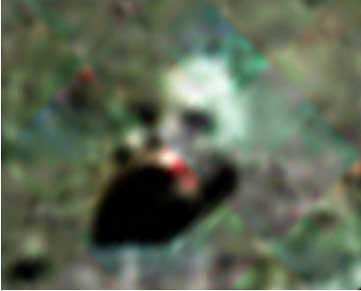
Photo processing
=============
I was interested in Hoagland's photo processing steps because I had seen one of the original Apollo 17 Hasselblad frames and could not understand how the "Data's Head" jpg could have been derived from it. Since Mike Bara, on the darkmission blog, had stated that this was a process that "anybody can repeat" I asked twice for guidance on the steps necessary to get from the whole frame to the highly decorated detail image. On the first occasion Bara replied that he was "not prepared to do your homework for you", and on the second occasion he replied "you don't know anything about how images are processed." Mr. Bara is neither polite nor helpful.

The image is a 7 kb file, 361 x 291 px., containing 34,509 colors (as measured by Paint Shop Pro v7.02 on a 2 GHz Hewlett-Packard Pavilion PC)
This is the information Hoagland offered, in a December 2007 interview for 'Project Camelot':
Kerry: (laughing more) You found a robot head in the bottom of a photograph...
Hoagland: In 14 photographs. It was photographed again and again and again and again as part of the panoramic sequence. We are trying now to go - we've gotten two copies of film - not just the web but film, (which is really crappy copies that were sent to us), and what I was able to do was a computerized robot comparison with C3PO.
....
I need higher resolution, but I've done some playing around on the computer even with those frames, and you get very interesting results. The two frames that were actually film that we used, we were able to superimpose them and that's when the eyes popped out.
The round irises, the camera eyes, that tell me this is not a desiccated human being lying there on the moon, one of the lunar colonists that we were positing was there at one point. This is an artificial life form, a robot.
So the "Data's Head" image was generated from two separate prints that Hoagland himself describes as "really crappy".
For my follow-up analysis, I ordered a very high definition scan from Houston Photo Imaging, a company that is trusted by the NASA photo library and can scan direct from the negative, ensuring highest possible definition. Anything but "crappy".
I don't know where Hoagland gets his count of 14 separate Hasselblad frames. Here is the complete inventory of that camera magazine -- I see the rock only on frames 21000, 21001, 21005, 21006 and 21027. I ordered frame 21000.
The scan was shipped on CD and was in tiff format, 46.1 MB, 5190 x 6175 px., 136,589 colors. It was processed as follows:
At stage 1, a rough crop was performed to isolate the skull-like rock and the feature known as "the turkey". This yielded a tiff of 564 KB, 522 x 560 px., 26,898 colors.
At stage 2, the image was rotated to match the orientation of Hoagland's image. It was discovered that Hoagland had rotated his image 45° counter-clockwise. The crop was then matched as closely as possible. The stage 2 tiff was 40 KB 181 x 145 px., 9,179 colors.
At stage 3, the image was enlarged by a factor of 2 to produce an image with the exact pixel dimensions of Hoagland's. The file was 111 KB, 18,439 colors.
For stage 4, the image was given to a trained Photoshop operator (Hoagland himself does not say what training he has had in photo enhancement. The safest assumption is 'none'.) The operator was asked to use any available image enhancement techniques to approach the style of Hoagland's manipulations. Software version was Adobe Photoshop CS2, v 9.0.2, on a 3 GHz PC running Windows XP.
- Tonality, color and contrast were altered using the 'Curves' feature. Input: 167 Output: 91.
- Shadows, midtones, and highlights were adjusted using the 'Levels' feature. Levels: 69, 1.00, 238.
The operator commented as follows:
All other adjustments to the photo, from reshaping the eyes, to darkening the shadow under the rock (and making the edges much more defined), and including adding shadow around the nose area, plus the odd color additions were made by someone, and not part of the original image.
The reference jpg is shown below, with the Hoagland original for direct comparison:
The photoshop file was 2,254 KB, 31,869 colors. The reference jpg is 60 KB, 18,907 colors. Note that this compares with the 7 kB of the Hoagland jpg, attesting to a high degree of compression (and consequently low fidelity). It's possible that a higher-quality master file was used for the book -- however, the overall quality of image repro in the book is so appalling it hardly matters.
Conclusion
=========
It is plain that Hoagland manipulated this image in ways that go far beyond what is considered legitimate image enhancement. Despite the monochrome general appearance of the moon's surface (and notwithstanding the famous orange soil that was discovered on the rim of this very crater), there is color in these images. However, the 34,509 colors of Hoagland's image bear witness to his artificial colorization. If you inspect a de-rotated version of the 'Data's Head' image, it becomes obvious that rectangular patches have been independently colorized and then re-superimposed on the frame.
It's not so obvious on the rotated version, and this may explain why he performed the rotation (which has no innocent motive that I can determine).
I do not see the "camera lenses" that he says he sees, but if they are there, they are far more likely to be the result of an imperfect superimposition of his two scans rather than anything real. Hoagland's superimposition technique is dangerous because any slight change in perspective from frame to frame can make true matching impossible.
The bright red jaw-piece that has been described as "anodized" is simply not there. It's an artifact of processing, whether by design or incompetence.
I can't help wondering whether Hoagland enlisted the services of the Minnesota design studio that designed his web site -- VA Graphics. This company offers expertise in photo restoration, especially "facial reconstruction" and addition of "special effects and fantasy art". The name under which this company operates that business? Glad you asked. It's FIXYOURPHOTOS.COM. How very, very apposite.
My conclusion is that Richard Hoagland's image is fraudulent, and I call on the publisher, Adam Parfrey, to delete it from future editions of the book.
Friday, May 30, 2008
Dork's Head?
There's been some discussion on the darkmission blog about the image that Richard Hoagland calls "Data's Head". This is a rock inside 'Shorty' crater, Station 4 of EVA2, Apollo 17 (the final moon mission).
The rock is skull-sized and has a superficial resemblance to a face of some kind. Hoagland maintains — on the basis of no evidence whatsoever other than his own intuition — that it is in fact a replica of the head of the robot C3PO from the Hollywood movie "Star Wars", made in 1977. Superficial resemblance is good enough for the authors, it seems. Mike Bara wrote on 22nd May "It's there (or it was there before they retrieved it), it looks like a head, it's the right size for a head, it looks like C3-PO's head. Period." According to Hoagland, an ancient lunar civilization anticipated the imagination of a 1970s special effects designer (Tony Dyson) and created a similar robot. Also according to Hoagland, either of the two Apollo 17 astronauts "could have" descended into the crater and retrieved this rock. In the Introduction to "Dark Mission", Hoagland goes further than the "could have" position and asserts that Apollo astronauts actually did bring back artifacts of the lunar civilization "for highly classified efforts at back engineering" [sic, he means reverse engineering]. Mike Bara conceded on an internet discussion in December 2007 that neither he nor Hoagland has any actual evidence to support this astoundingly bold claim.
The fact is that the Apollo 17 astronauts could not have retrieved this rock, for the following reasons.
1. It cannot be recognized as being "face-like" with the unaided human eye from the position the astronauts were in, at the crater rim. This was their view, as recorded by the hand-held Hasselblad camera.
2. They had no means of descending the steep side of the crater — not to mention getting back up, carrying a rather heavy object even allowing for reduced lunar gravity.
3. Even if they had wished to do so, they would undoubtedly have been forbidden to by Mission Control. The EVA was already running late, and the transcript shows clearly that Mission Control was constantly reminding them of walk-back constraints at this station.
4. No discussion of this is heard on the tapes of this station. It's inconceivable that the astronauts would have contemplated such a risky venture without discussion. It's impossible that such discussion was edited out because this was happening on live TV all across Planet Earth.
5. They had no means of picking up a skull-sized rock. The hand-held scoop was sized for "fist-sized" rocks only, and the rake was completely inadequate (see pp 52-54 here). It is not possible to bend down and pick up such a rock by hand when wearing the lunar spacesuit.
In addition, the "Data's Head" image is suspect. In the book, the authors write vaguely that it was arrived at by "processing and color enhancement" from the Hasselblad frame. What exactly does "processing and color enhancement" mean in this context?
Mike Bara has written twice that this process can be repeated by anyone. When I asked for details of the "processing and color enhancement" so that I might attempt to repeat it, Bara went into his "scorn and insult" mode and wrote (May 22nd) that "you don't know anything about how images are processed."
I wrote in reply that I was not going to comment on my level of expertise in image processing for the simple reason that it was beside the point. On May 28th, marsandro wrote "Okay. So...the point is...?"
Mike Bara's wishful use of the word "Period" on May 22nd makes it clear that superficial resemblance is all the evidence he needs to draw his conclusion, and no further discussion is necessary or permissible — a position so profoundly unscientific that it makes one gasp. And in fact, he used his veto as moderator of darkmission.net to suppress the following answer to marsandro's question.
>>"Okay. So...the point is...?"<<
....that Mike Bara refuses to specify the processing steps required to get from this to this. It's clear that it was enlarged x7 approximately, but what else was done? Here are some of the processing techniques that might have been used:
Adjustment of brightness, contrast, color balance, gamma.
Correction of highlights, midtones and shadows independently.
Correction of hue, saturation and lightness.
RGB adjustment.
Sharpening, edge enhancement, gaussian blurring.
Despeckle, moiré removal, fade correction.
....and that's before you even think about the so-called "artistic" effects like posterization.
Subscribe to:
Posts (Atom)